Weekly Unlock Digest: June 15-21, 2026 | SpaceX IPO


🔑 Key Takeaways
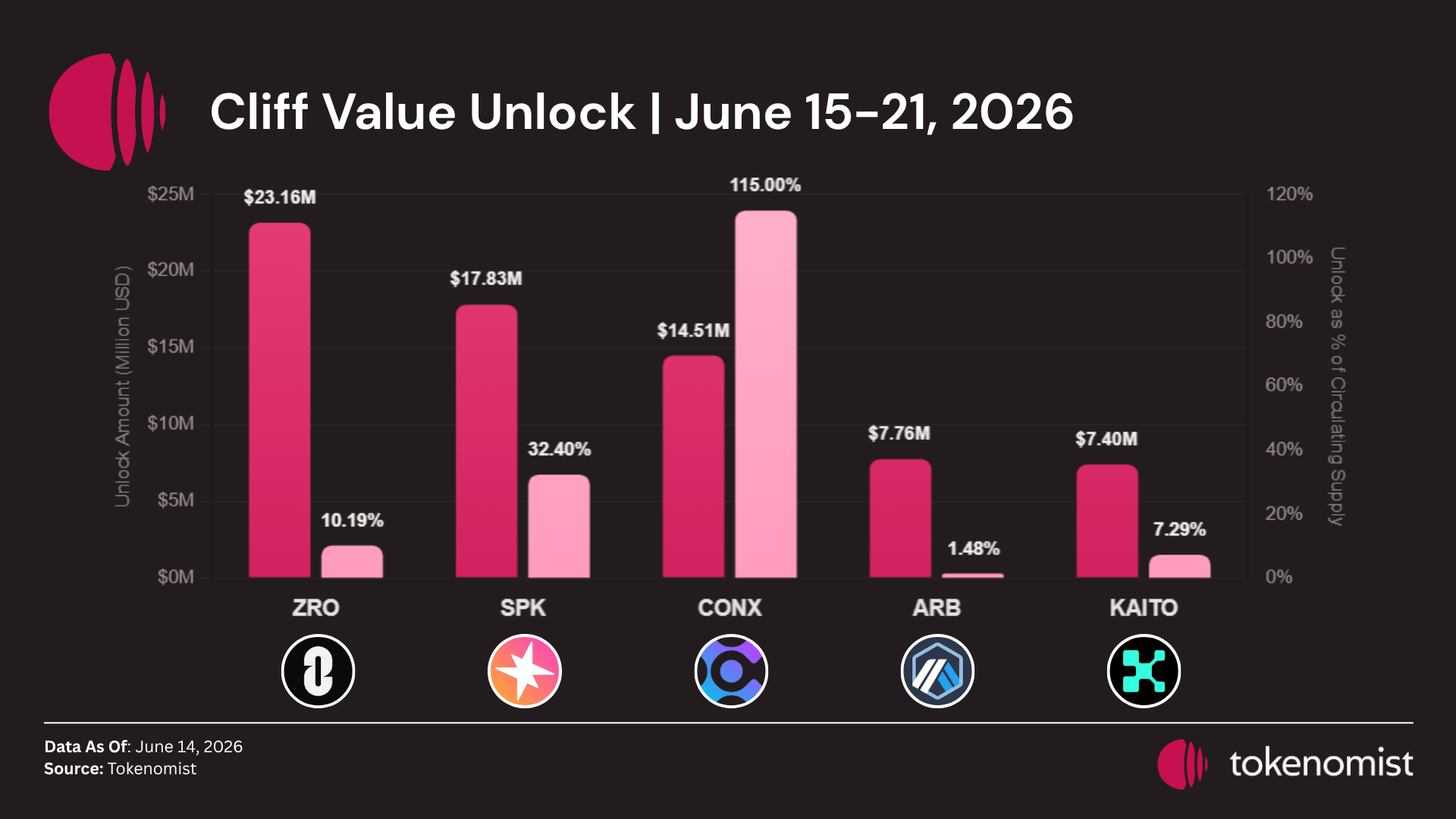
- $ZRO releases $23M (4.83% of circulating supply) on June 20, a release that notably includes a slice of Strategic Partners and Core Contributors.
- SpaceX's $75B IPO locked up 95.8% of shares, creating a staggered $323B overhang that mirrors the cliff-and-vest mechanics crypto investors track every week.
- io.net replaced fixed emissions with a demand-linked model, tying IO supply expansion (and burns) directly to network earnings rather than a preset schedule.
Weekly Recap
After the prior week's steep drawdown, markets steadied. Bitcoin found a floor near $61K before recovering toward the $63–64K area, and spot BTC ETF flows turned positive by June 13, a tentative signal that the local low may be in. Ether lagged the recovery, trading roughly $1,670–1,700 and sitting around 65% below its all-time high as ETF outflows eased but didn't fully reverse.
The week's defining headline came from outside crypto-native markets: SpaceX went public on June 12, raising about $75B and instantly ranking among the largest corporate Bitcoin holders. Sentiment elsewhere stayed cautious — strong US jobs data trimmed expectations for a near-term Fed cut, leaving the June 16–17 FOMC meeting, which lands inside this reporting week, as the key macro catalyst.
Upcoming Events
Next week’s scheduled token releases are set to exceed $660 Million in total value. Top tokens facing the largest cliff unlocks next week include $ZRO, $SPK, $CONX, $ARB, and $KAITO.
Unlocks Spotlight: $ZRO
- Unlock Date: June 20, 2026
- Amount: $23M
- Unlock as % of Circulating Supply: 4.83%
- Vested Allocations: Strategic Partners, Core Contributors, and Token Repurchased
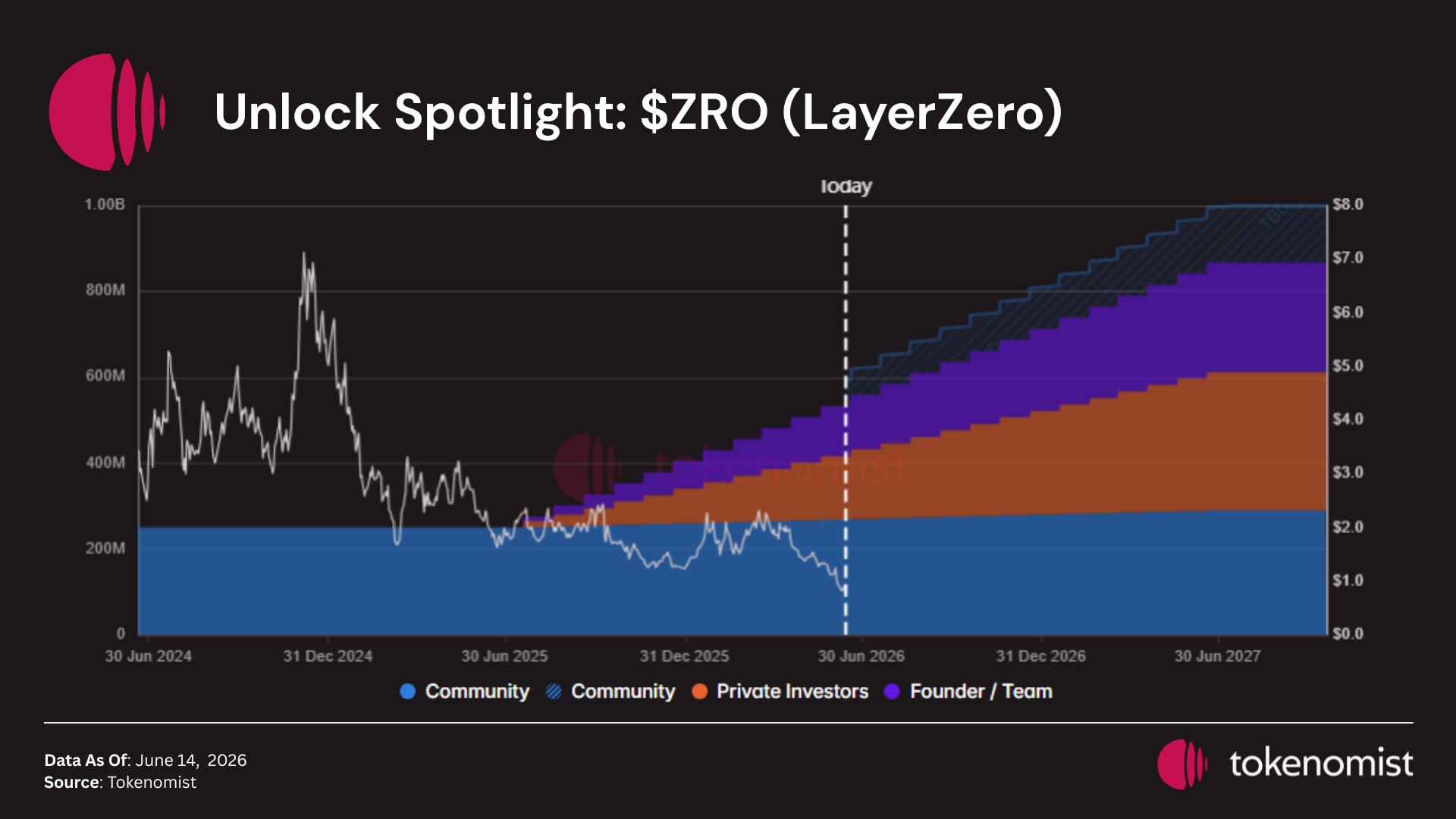
LayerZero's omnichain interoperability token sees a more modest release in float terms, but the composition is the interesting part: the tranche includes Tokens Repurchased, a category created when the Foundation bought back 50M tokens from early investors — partially offsetting insider dilution rather than adding net new insider supply. The remainder vests to Strategic Partners and Core Contributors, the two largest allocation buckets, against a cliff-style schedule. With ZRO still building toward its own "Zero" L1 (targeted for fall 2026), the near-term question is whether infrastructure demand keeps pace with the ongoing vesting cadence.
SpaceX IPO Brings Unlock Analysis to Equities
The week's most novel data story isn't on-chain at all. SpaceX's June 12 listing (NASDAQ: SPCX) priced at $135/share for a $75B all-primary raise and a $1.77T fully diluted valuation — and Tokenomist has published a lockup-and-vesting tracker concept applying the same unlock framework used for tokens to a traditional equity float.
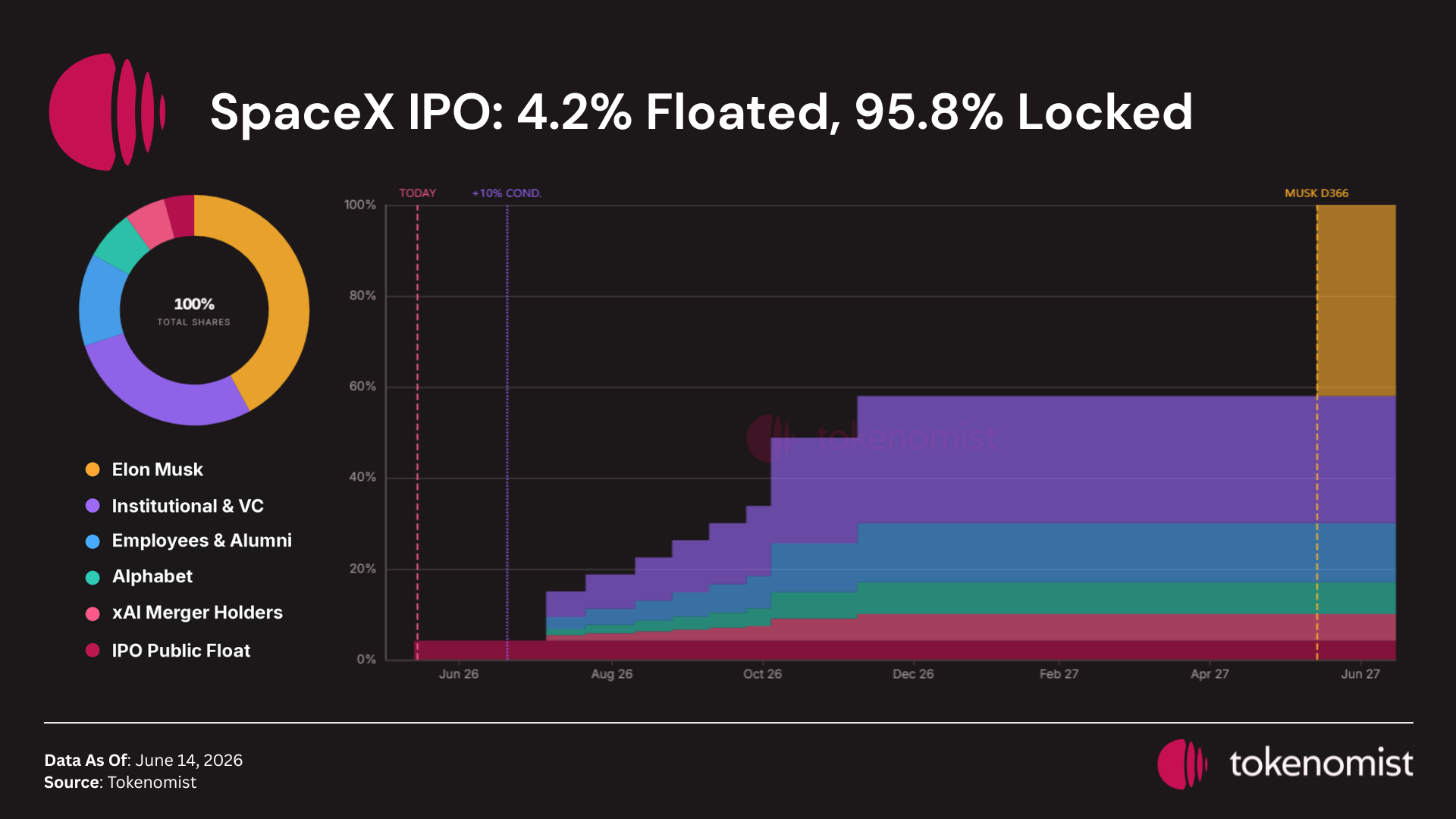
The parallels are direct. Of SpaceX's 13.11B fully diluted shares, the IPO floated just 555.6M (4.2%), leaving 95.8% locked — a structure functionally identical to a low-float token launch with heavy insider vesting. Rather than a single 180-day cliff, the lockup releases in staggered tranches: a 20% insider cliff tied to Q2 earnings (early August), a series of time-based 7% windows through the autumn, a larger Q3-linked release in November, and a 180-day expiry in December. Elon Musk's 42% stake (and 82.4% voting power under a dual-class structure) sits behind a 366-day founder lockup that doesn't expire until June 2027. The tracker flags the near-term overhang as high: up to 2.4B shares ($323B), roughly 4.3x the public float, become eligible within 90 days — though eligible does not mean sold, and the staggering is designed to meter supply rather than dump it.
Notable Tokenomics Updates
io.net ($IO) — Demand-Linked Emissions
io.net replaced its fixed emission schedule with the Incentive Dynamic Engine (IDE), which ties both emissions and burns to network earnings. Instead of releasing a preset quantity of IO regardless of usage, the model pays GPU suppliers a stable dollar target and mints only as much IO as needed at the live price; once payouts are covered, a portion of the surplus is directed toward burns. The change addresses a structural problem common to DePIN networks — supply that grows on a schedule even when demand doesn't — by making issuance a function of activity rather than a calendar. Whether it reduces net supply over time depends on sustained network earnings, which the project reports have trended upward since March.
The future of AI compute doesn't run on hype.
— io.net (@ionet) June 11, 2026
It runs on real utility, real burns, and a network that gets stronger every time it's used.
The Incentive Dynamic Engine (IDE) is now live!https://t.co/ggOg5dBdZw pic.twitter.com/Ylmj9jH0d0
Recommend Article