HYPE Tokenomics: ~330K or 9.9M $HYPE Unlocks?

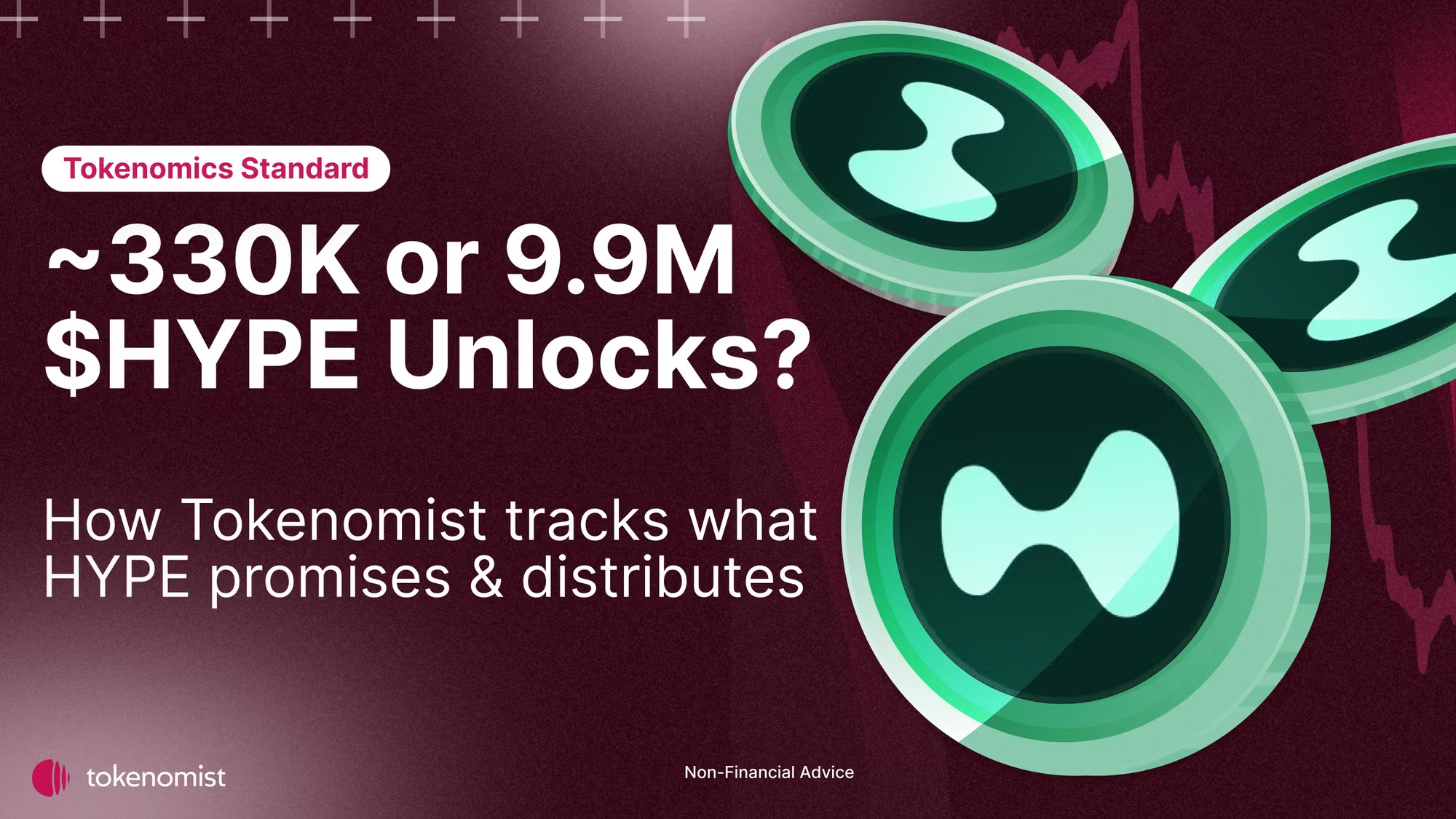
When Projected Unlock and Announced Claim Diverge: Methodology, Data, and a New Tracking Standard
Key Takeaways (TL;DR)
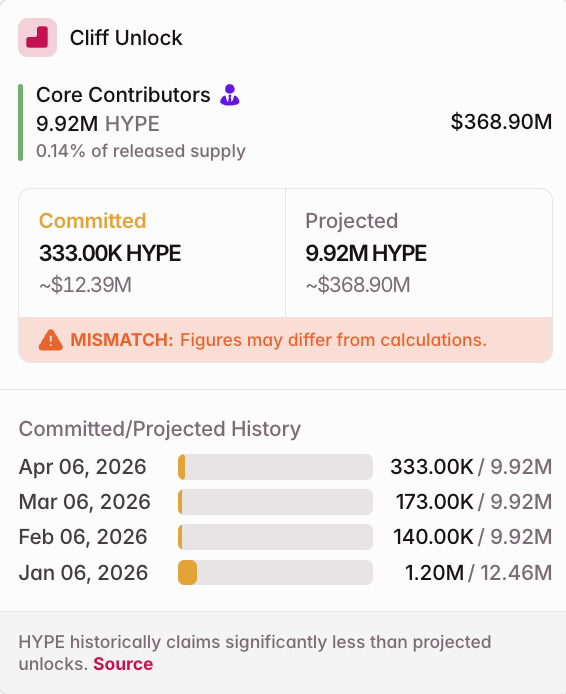
- The gap: Hyperliquid's April 2026 announced claim is ~330,000 HYPE (~$12.1M). The projected unlock from the whitepaper schedule is 9,916,666 HYPE (~$364M). That is a ~30x difference, and both numbers are correct.
- The problem: Most unlock calendars show only the projected unlock, the ceiling. For HYPE, this overstated actual supply pressure by 30–57x across five tracked months.
- The new standard: Tokenomist now tracks HYPE unlocks through three stages: Whitepaper Estimate → Committed → Completed. Both projected and announced figures are displayed side-by-side with verified claim status.
- Where to see it: tokenomist.ai/hyperliquid (unlock card with dual metrics) and tokenomist.ai/hyperliquid/supply-analytics (full dashboard with burn, buyback, and claim history). Free for all users.
- Why it matters: For investors, the difference between "$364M monthly unlock risk" and "$12M actual monthly claim" changes the supply risk assessment entirely. For Hyperliquid, the new standard makes their distribution restraint visible in the data, fairer representation backed by on-chain verification.
Executive Summary
- The Hyper Foundation has announced ~330,000 HYPE tokens for distribution in April 2026, the fifth monthly cycle tracked by Tokenomist. The whitepaper-derived projected unlock for the same period: 9,916,666 HYPE, a ~30x discrepancy. The April announced claim is nearly double March's 173,217 HYPE, but still represents only ~3.3% of the projected ceiling.
- Across five months of tracked data (December 2025 omitted, no public announcement record identified), the Hyperliquid team's actual claimed amount has ranged from 1.4% of the projected figure (February 2026) to 17.6% (November 2025), establishing a consistent behavioral pattern below the theoretical ceiling. April's ~3.3% continues this pattern.
- Cumulative record through March 2026: 405.41M HYPE have been unlocked at the vesting contract level (On-chain Verified, Day precision); ~3.19M HYPE have been claimed and entered circulation, a ~0.79% claim rate. With the April ~330K claim pending execution, cumulative claimed will reach ~3.52M.
- The discrepancy originates from Hyperliquid's discretionary distribution structure, which does not conform to the standard linear vesting model. Tokenomist now tracks this through a three-stage verification pipeline: Whitepaper Estimate → Team Announcement (Committed) → On-chain Claim (Completed).
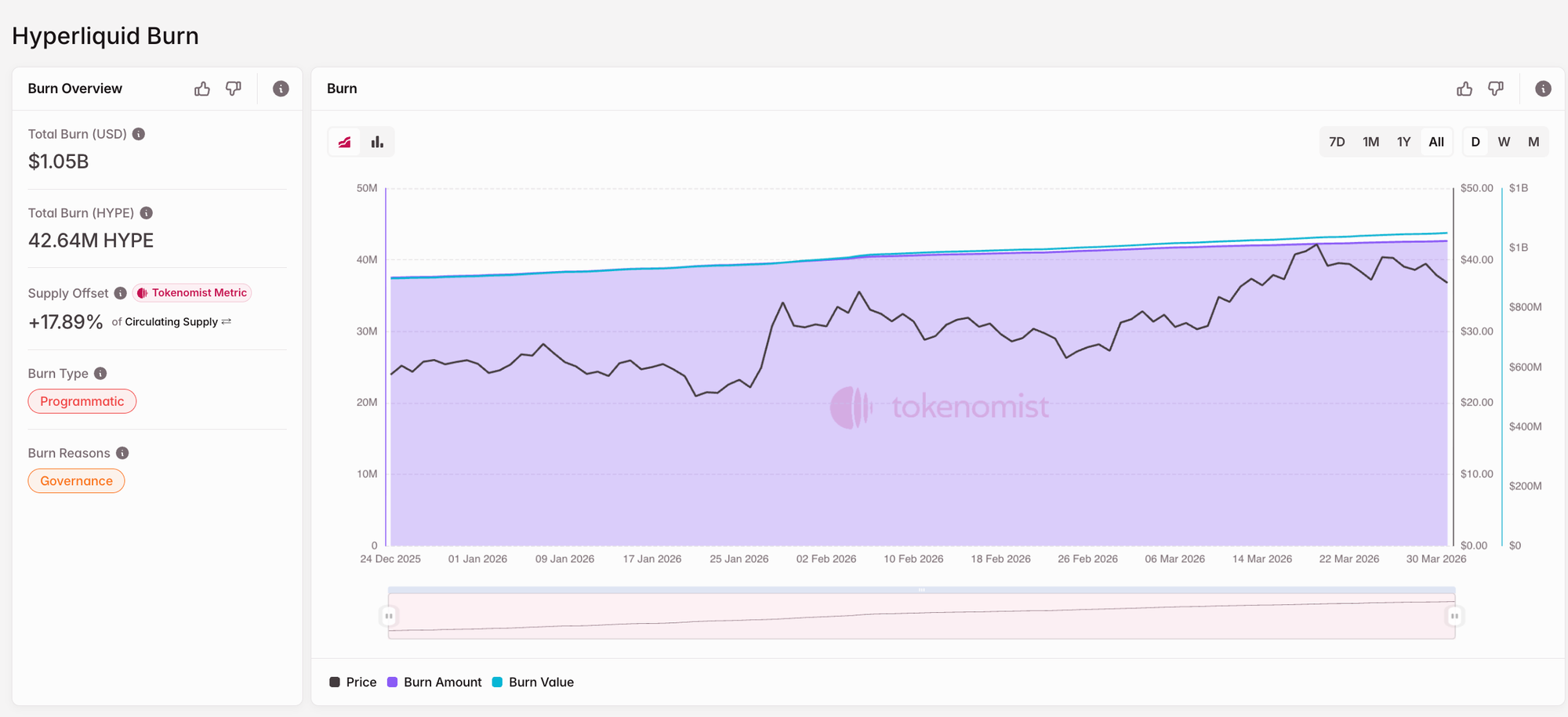
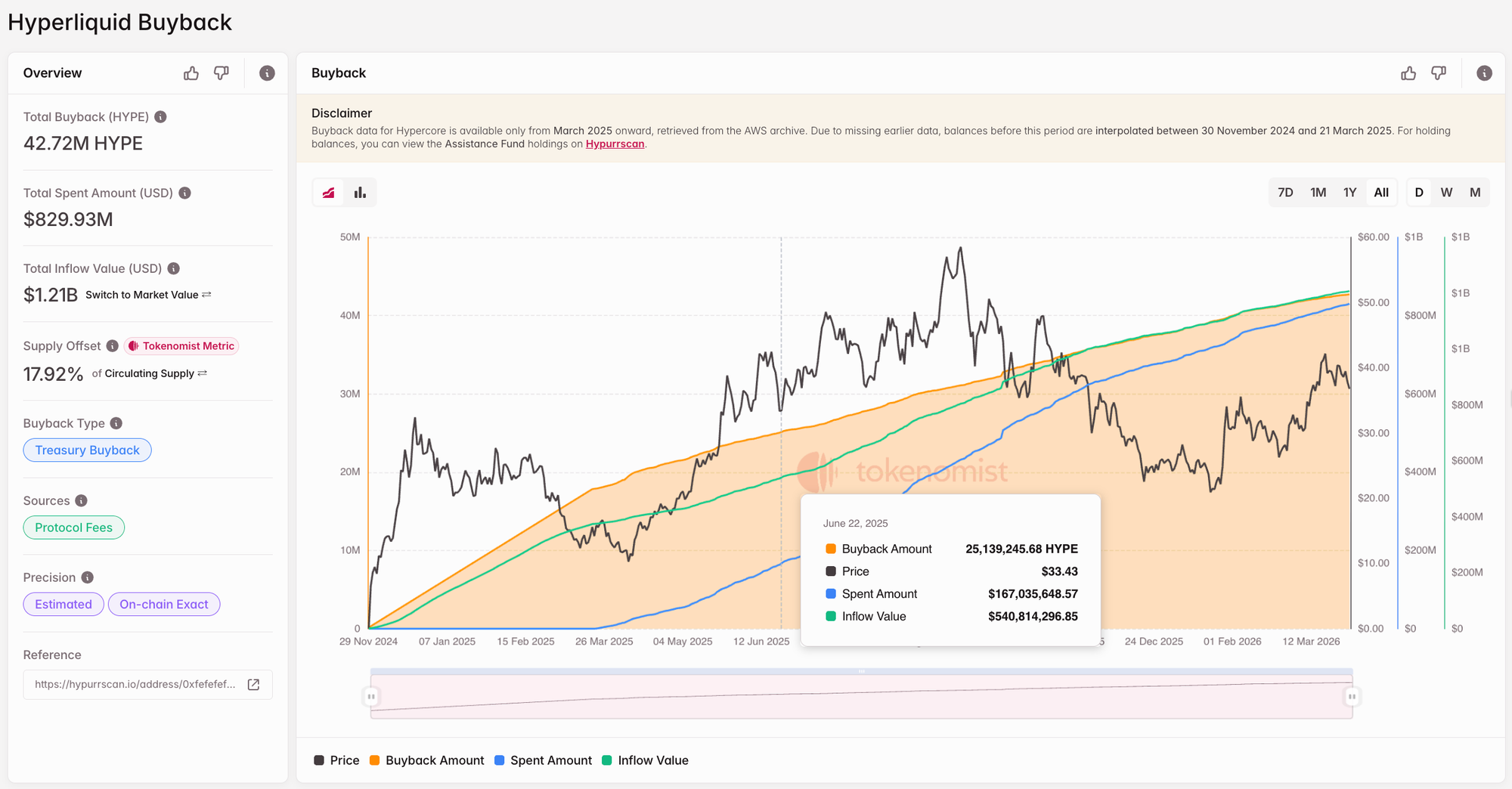
- Tokenomist's tokenomist.ai/hyperliquid and supply-analytics pages display both Projected Unlock and Announced Claim as distinct, labeled metrics, alongside burn rate (10.27%), buyback rate (10.29%), and cumulative on-chain claims ($119.52M). "Announced Claim" is a formal data category in Tokenomist's taxonomy. New to these terms? See the full glossary at tokenomist.ai/learn.
Methodology Note
How HYPE unlock data is sourced and labeled in this report:
All on-chain claim data is sourced from tokenomist.ai/hyperliquid/supply-analytics and cross-referenced with public transaction records. Projected unlock figures are calculated from the Hyperliquid whitepaper vesting schedule (updated December 29, 2025) using Tokenomist's standard linear methodology, documented at docs.tokenomist.ai/methodology. USD valuations use contemporaneous prices at the time of each claim event, except where "current prices" is specified (April 1, 2026: ~$36.75/HYPE per CoinGecko).
Data label conventions used throughout:
- Public Project Data & On-chain Verified, Day precision: figures sourced from public team announcements and confirmed against on-chain transactions (learn more)
- Public Project Data, Month precision: figures derived from whitepaper vesting schedule; linear model applied
- On-chain Verified, Day precision: figures sourced directly from vesting contract state
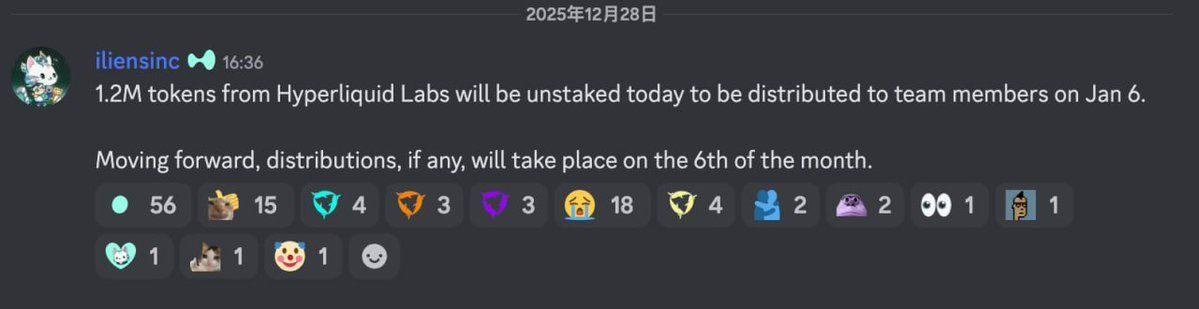
December 2025 had no separate distribution event. On December 28, 2025, Hyperliquid co-founder Iliensinc announced on Discord that 1.2M HYPE tokens were being unstaked in preparation for the January 6, 2026 distribution, establishing the 6th-of-month cadence for all future distributions (Source: crypto.news). The December unstaking and the January distribution refer to the same 1.2M tokens, so December is not listed as a separate row in the comparison table.
Vesting schedule version note: Tokenomist's HYPE data uses the latest published vesting schedule (updated December 29, 2025), which includes the Core-contributor Token Release Schedule Update. All months use a uniform ~9.92M HYPE/month projected unlock (238M Core Contributor allocation / 24 months). Earlier schedule versions may have produced different monthly projections.
The Data: Projected Unlock vs. Announced Claim
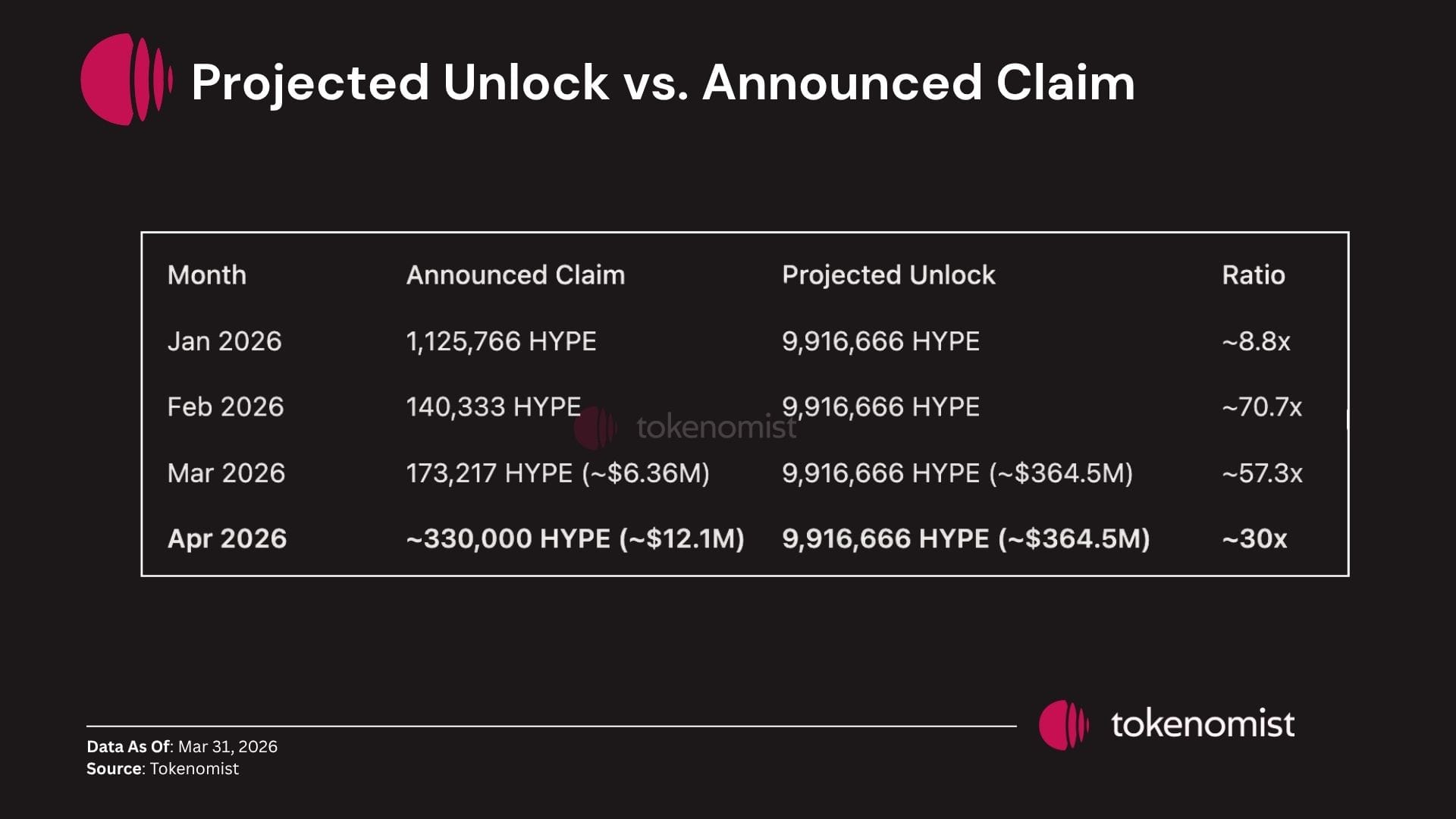
Source: (31th March 2026)Nov–Mar verified via Tokenomist data. Apr announced claim sourced from Hyper Foundation announcement (Committed status — pending on-chain execution on April 6). Vesting schedule updated December 29, 2025.
April context: The ~330K announced claim is nearly double March's 173K — the first month-over-month increase since November 2025. At ~3.3% of the projected ceiling, it remains well below the theoretical maximum but represents a directional shift worth monitoring. This is exactly the kind of behavioral signal the dual-metric system is designed to surface.
Understanding the Discrepancy: and Why It Matters for Fair Representation
Standard unlock calendars, including Tokenomist's own prior display, showed one number for HYPE: the Projected Unlock of ~9.92M tokens/month (~$364M at current prices). This figure was derived from the whitepaper's 24-month linear vesting for the 238M Core Contributor allocation. For most tokens Tokenomist tracks, this linear model is accurate enough to be useful.
For HYPE, the model was accurate as a ceiling. It was incomplete as a representation of actual supply behavior.
The Hyper Foundation has publicly stated that most vesting actually completes between 2027 and 2028, a schedule that does not conform to a uniform 24-month linear distribution from TGE. More consequentially, Hyperliquid's actual distribution is discretionary: the team announces a specific claim amount on the 6th of each month, and that announced amount has consistently been well below the theoretical maximum.

Why this distinction makes analysis fairer for Hyperliquid, and more useful for investors:
- For Hyperliquid: Reporting only the $364M projected unlock created a narrative of massive supply pressure that did not match the team's actual behavior. The team was voluntarily distributing far less than authorized, a positive signal that was invisible under the single-metric standard. The new dual-metric display gives credit for restraint that is verifiable on-chain.
- For investors: The projected unlock alone overstated supply risk by 30–57x across tracked months. An investor using only the ceiling figure in their supply model would have materially overestimated dilution. The announced claim, backed by on-chain verification, provides the actual expected supply impact.
- For the market: CoinTelegraph published "Hyperliquid's $314M unlock fuels calls for clarity, sell-pressure warnings." Community member "Andy" wrote an open letter requesting proactive communication. On Followin.io, a viral thread asked: "Is the announcement of nearly 10 million team tokens a misunderstanding?" These reactions were rational responses to incomplete data. The dual-metric standard resolves this information gap.
The structural definitions:
- Projected Unlock is an authorization, the maximum possible supply expansion under the vesting contract terms. It is a ceiling.
- Announced Claim is an execution commitment, the specific amount the project has publicly stated they will claim. When confirmed on-chain, it becomes a verifiable, auditable record. A subsequent claim exceeding the announced figure constitutes a verifiable breach of that commitment.

The distinction changes the supply impact calculation entirely. 30x (April) to 57x (March) is not a rounding error: it is the difference between a $364M supply pressure event and a $12M supply event.
On-Chain Behavior: The Claim Record
Cumulative vesting contract state as of March 23, 2026 (On-chain Verified, Day precision):
- Total Unlocked: 405.41M HYPE
- Total Claimed: ~3.19M HYPE
- Claim rate against total unlocked: ~0.79%
- Tokens remaining in vesting wallets, unclaimed: ~402.22M HYPE
- Cumulative on-chain claims value: $119.52M (tokenomist.ai/hyperliquid)
April projection: With the ~330K announced claim pending execution on April 6, cumulative claimed currently at ~3.18M HYPE and will reach ~3.52M HYPE in April. The projected unlock adds another 9.92M to total unlocked (reaching ~415.33M), bringing the claim rate to ~0.85%.
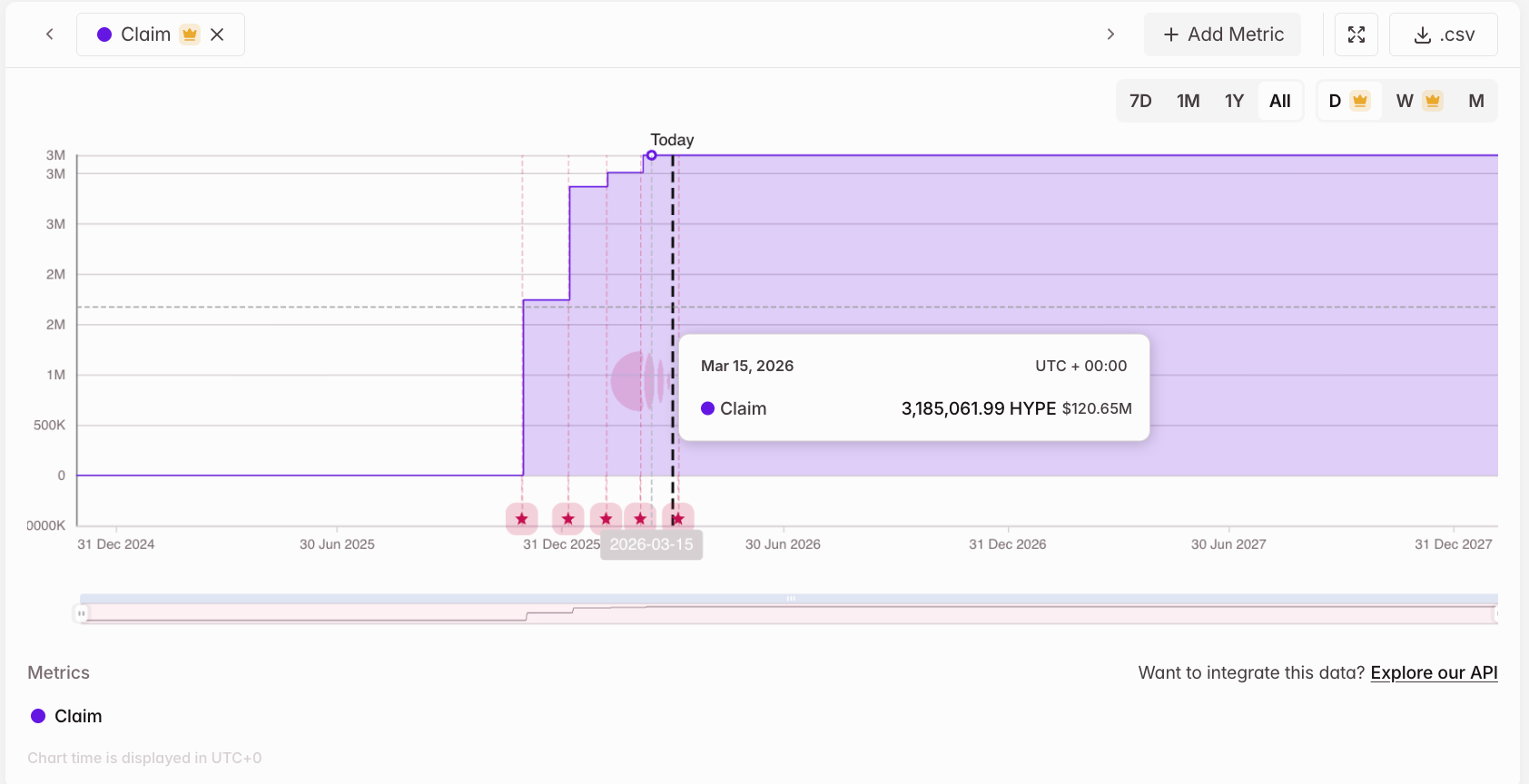
Full on-chain claim detail, individual claimer addresses, dates, amounts, and prices at time of claim: tokenomist.ai/hyperliquid/supply-analytics
What Tokenomist Now Tracks: The Three-Stage Verification Pipeline
Tokenomist's supply-analytics page introduces a three-stage tracking model for HYPE unlock events:
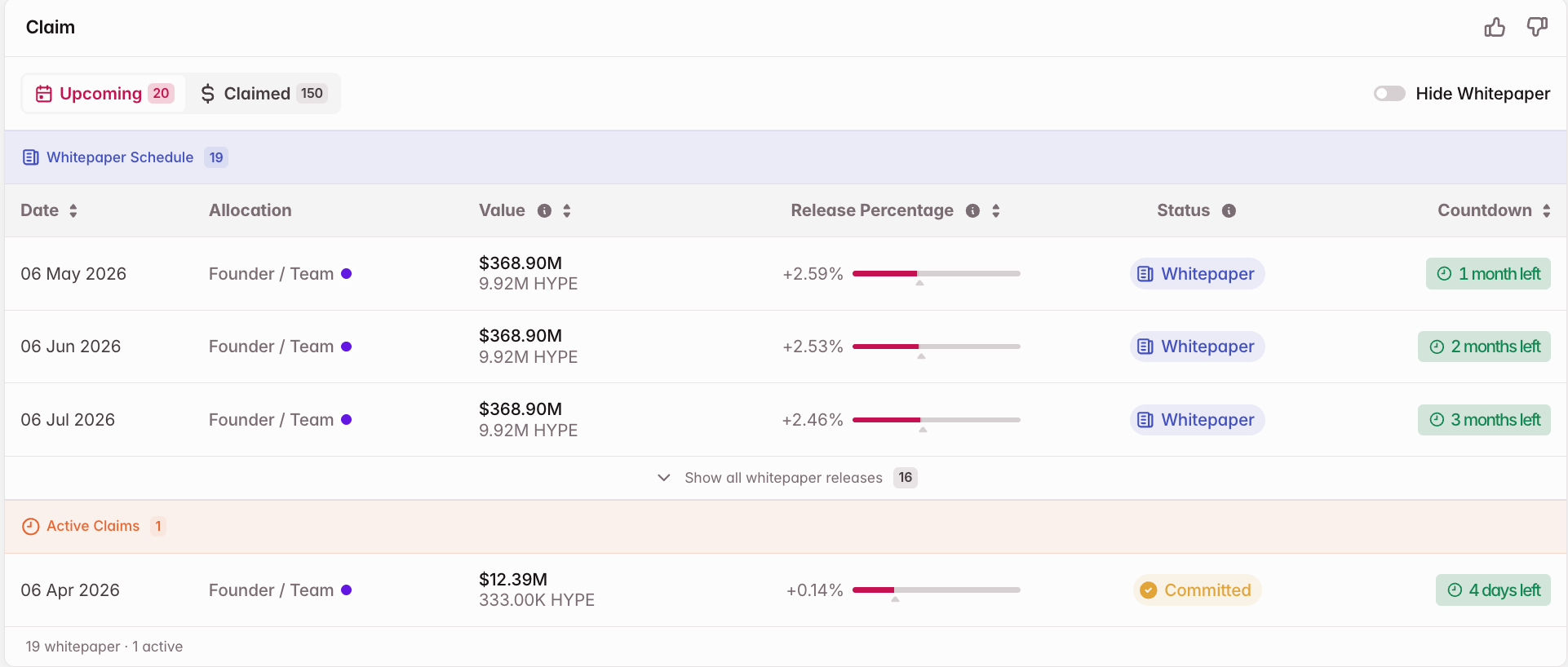
Stage 1: Whitepaper Estimate: The projected unlock derived from the published vesting schedule. This is the ceiling, the maximum that can enter circulation. For HYPE: ~9.92M tokens/month.
Stage 2: Team Announcement (Committed): The specific amount the Hyper Foundation announces on the 6th of each month. This is the expected case, what the team says they will claim. Displayed with a "Committed" claim status. April's current status: ~330K HYPE, Committed.
Stage 3: On-chain Claim (Completed): The actual on-chain transaction that executes the claim. This is the verified outcome. Displayed with a "Completed" claim status and verified badge confirming the on-chain transaction matches the announcement.
Each unlock event progresses through these stages publicly, creating an auditable record: estimate → commitment → execution.
How to Use This Feature — A Practical Guide
For any investor or analyst evaluating HYPE supply pressure, here is how to read the new Tokenomist display:
Step 1: Check the next unlock event. Go to tokenomist.ai/hyperliquid. The unlock card shows the next projected unlock date (currently April 6, 2026) and the projected amount (~9.92M HYPE). This is the ceiling, the maximum possible. (What is a projected unlock?)
Step 2: Check if the team has announced. The Hyper Foundation typically announces the actual claim amount around the 6th of each month. When this happens, the unlock card updates to show both the projected figure and the announced claim side-by-side. The announced figure carries a "Committed" status. Right now, April shows ~330K HYPE Committed, that is the expected supply impact, not 9.92M.
Step 3: Verify on-chain after execution. After the team executes the claim, the status updates to "Completed" with a verified badge. The on-chain transaction confirms the announcement was honored. (What does Completed mean?)
Step 4: Explore the full supply picture. Visit tokenomist.ai/hyperliquid/supply-analytics for:
- Cumulative unlocked vs. claimed: see how much sits unclaimed in vesting wallets
- Burn rate (10.27%) and buyback rate (10.29%): protocol-level demand mechanisms
- On-chain claims total ($119.52M): cumulative value of all executed claims
- Individual claimer addresses with dates, amounts, and prices at time of claim
What to look for:
- Claim percentage trending down = team distributing less over time
- Claim percentage trending up = team distributing more, worth monitoring. April's ~3.3% is up from March's 1.7%, but still well below the Nov 2025 peak of 17.6%
- Announced claim significantly exceeding prior months = potential shift in distribution behavior
- Burn + buyback rates = protocol-level demand mechanisms offsetting supply pressure
The accountability mechanism: If a team announces ~330K tokens and then claims 1M on-chain, that discrepancy is visible to everyone. The three-stage pipeline makes promises verifiable and deviations detectable.
This is free at https://tokenomist.ai/hyperliquid/
No paywall for the core tracking data. New to tokenomics terminology? The full glossary is at tokenomist.ai/learn.
The Community Information Environment
In the absence of a standard for distinguishing "authorized to unlock" from "actually claimed," the projected figure circulated as the primary reference. The result was four months of market anxiety driven by incomplete data.
Media coverage amplified the ceiling figure:
- CoinTelegraph: "Hyperliquid's $314M unlock fuels calls for clarity, sell-pressure warnings", accurately reported the projected unlock, but the headline framed it as imminent supply risk.
- CryptoNews: "Hyperliquid Token Unlock Puts $314M At Risk As Transparency Fears Rattle Traders", described the unlock as putting capital "at risk," reinforcing the sell-pressure narrative.
- CoinMarketCap: "Hyperliquid Faces $314M Token Unlock Amid Pressure", framed the event as a pressure point without distinguishing projected from actual distribution.
- The Defiant: "HYPE Drops Below $50 as Unlock Fears Intensify", connected the price decline directly to unlock fear.
Community reaction reflected genuine confusion:
- Community member "Andy" published an open letter on X urging the Hyperliquid team to address holders before the unlock, citing "fears of historical sell-off patterns and emotional scars from prior token events." The community response was divided, some argued the team owed transparency, others said publishing the schedule was sufficient.
- On Followin.io, a viral thread asked: "Is the announcement of nearly 10 million team tokens a misunderstanding?", reflecting genuine uncertainty in Asian crypto communities about which figure represented the correct reference for supply analysis.
Analysts who looked deeper reached different conclusions:
- DCo (decentralised.co) published a contextualization thread on X, noting as long-term investors that the Hyper Foundation blog states most vesting completes between 2027 and 2028, and that monthly fee revenue ($204M–$317M) could offset the supply expansion without requiring additional market demand.
- BitMEX co-founder Arthur Hayes initially exited his HYPE position at approximately $50–55, posting on X: "Even if the team pinky swears to not sell, there is nothing holding them to that, assume >0% daily sell pressure." His reasoning was explicit, the standard framework showed no binding commitment and a large theoretical overhang. After multiple months of on-chain data showing consistent sub-18% claim rates against theoretical maximums, Hayes reversed his position at approximately $20, the January 2026 trough, and told CoinDesk he set a $150 price target by August 2026 (Public Statement, attributed to Arthur Hayes, not Tokenomist analysis). The data available at the time of re-entry included the same on-chain claim record documented in this report.
Every one of these reactions, the media coverage, the community anxiety, the analyst divergence, was a rational response to an information gap that the dual-metric standard now closes.
The Standard: What "Announced Claim" Means for Reporting
Any token with a discretionary distribution mechanism, where team members have the right to claim up to a maximum but are not obligated to claim the full amount, will be miscategorized by a pure linear unlock model. The projected figure will consistently overstate actual supply pressure.
The reporting framework Tokenomist has introduced:
Projected Unlock = the maximum that can enter circulation. Treat it as the ceiling and worst case.
Announced Claim = the project's on-chain commitment for the period. Treat it as the expected case.
Presenting both metrics gives the full supply range: a ceiling defined by the vesting contract and a floor defined by the team's stated intentions. The gap between them is information, not noise. A consistent pattern of small claims against a high ceiling is a behavioral data point. A team that consistently claims close to its ceiling produces a different signal.
The accountability mechanism is specific: a team that announces ~330K and claims 1M has made a verifiable, public commitment and broken it. On-chain verification closes the accountability gap that verbal assurances leave open.
Implications for Analysts and Fund Managers
With three major asset managers. Grayscale, Bitwise, and 21Shares, filing HYPE ETF products in March 2026, institutional due diligence on HYPE supply dynamics is no longer theoretical. The difference between "$364M monthly unlock risk" and "$12M actual monthly claim" (April's ~330K at current prices) is the difference between a red flag and a green light on a standard due diligence checklist.
The same structural question applies to any token with discretionary distribution mechanics: is the projected unlock the correct input for supply risk modeling, or is the announced claim? For most tokens these converge. For tokens structured like HYPE, they do not, and the methodology must reflect that.
For token teams: Proactive, on-chain monthly announcements made before each distribution event transform the information environment. They create a verifiable, time-stamped behavioral record. They give data infrastructure the raw material to represent actual behavior accurately, rather than defaulting to the worst-case linear projection.
Full HYPE unlock data, announced claim history, and supply analytics: tokenomist.ai/hyperliquid.
Supply-analytics dashboard: tokenomist.ai/hyperliquid/supply-analytics.
API access: enterprise.tokenomist.ai
Glossary: tokenomist.ai/learn.
The Broader HYPE Context
April 2026 context for HYPE:
- HYPE all-time high: $59.30 (September 18, 2025). Current price: ~$36.75 (April 1, 2026). Market cap: ~$8.77 billion. CoinGecko rank: #16. (Market Data, Day precision, Source: CoinGecko)
- Circulating supply: 238.39M HYPE. Total supply: 962.27M. Max supply: 1B. FDV: ~$35.4B. (Market Data, Day precision, Source: CoinGecko)
- TVL: $5.37B (CoinGecko); Hyperliquid L1 chain TVL: $1.68B (Source: DefiLlama) (Public Project Data, Day precision)
- Grayscale, Bitwise, and 21Shares filed HYPE ETF products in March 2026 (Public Project Data, Day precision)
- Zero VC allocation: Hyperliquid had no venture capital investors, a structural differentiator in its tokenomics (Source: Tokenomist)
- Burn rate: 10.27% | Buyback rate: 10.29%, protocol-level, non-discretionary deflation mechanisms (Source: tokenomist.ai/hyperliquid)
- On-chain claims total: $119.52M cumulative (Source: tokenomist.ai/hyperliquid)
Appendix / Sources
Verified Sources:
- CoinGecko HYPE data: coingecko.com/en/coins/hyperliquid — ATH $59.30 confirmed, market cap rank #16, circulating supply 238.39M
- DefiLlama Hyperliquid chain: defillama.com/chain/Hyperliquid — L1 chain TVL $1.68B
- Tokenomist HYPE page: tokenomist.ai/hyperliquid — burn 10.27%, buyback 10.29%, on-chain claims $119.52M
- Tokenomist Supply Analytics: tokenomist.ai/hyperliquid/supply-analytics — three-stage claim tracking pipeline
- Tokenomist Glossary: tokenomist.ai/learn — 59 tokenomics terms defined
- Tokenomist internal data — HYPE vesting schedule (updated December 29, 2025): claim amounts verified (Nov: 1,745,746; Jan: 1,125,766; Feb: 140,333; Mar: 173,217)
- Tokenomist launch announcement: x.com/ApeWAGMI/status/2038967155946090907
- CoinTelegraph: "Hyperliquid's $314M unlock fuels calls for clarity, sell-pressure warnings" — cointelegraph.com
- Phemex: "Hyperliquid Labs Unlocks 173,000 HYPE Tokens" — phemex.com
- Followin.io: "Is the announcement of nearly 10 million team tokens a misunderstanding?" — followin.io/en/trendingTopic/4514
- DCo reassurance thread — x.com/Decentralisedco
- Tokenomist methodology docs — docs.tokenomist.ai/methodology
FAQ
What is the difference between a projected unlock and an announced claim?
A projected unlock is the maximum amount of tokens that can enter circulation based on the vesting schedule, it is the ceiling. An announced claim is the specific amount the project team has publicly committed to actually claiming, it is the expected case. For HYPE, the gap between these two has ranged from 5.7x to 70.7x.
Why does Hyperliquid's projected unlock not match its actual distribution?
Hyperliquid uses a discretionary distribution model. The whitepaper describes a 24-month linear vesting for 238M Core Contributor tokens (~9.92M/month), but the Hyper Foundation distributes voluntarily and has consistently claimed far less than the authorized maximum. The team has stated most vesting completes between 2027 and 2028.
How can I track HYPE's actual unlock vs. claimed amount?
Visit tokenomist.ai/hyperliquid to see the next unlock with both projected and announced figures. For the full dashboard, including burn rate, buyback rate, cumulative claims, and individual claimer addresses, visit tokenomist.ai/hyperliquid/supply-analytics. Both are free.
What does "Committed" vs "Completed" mean on the Tokenomist unlock card?
"Committed" means the team has announced the claim amount but the on-chain transaction has not yet executed. "Completed" means the claim has been executed on-chain and verified against the announcement. This three-stage pipeline (Whitepaper Estimate → Committed → Completed) creates an auditable record.
Is the ~330K HYPE April claim higher than previous months?
Yes. April's ~330K is nearly double March's 173,217, making it the first month-over-month increase since November 2025. However, at ~3.3% of the projected 9.92M ceiling, it remains well below the theoretical maximum. The overall pattern of distributing far below authorization continues.
What is HYPE's all-time high and current price?
HYPE reached an all-time high of $59.30 on September 18, 2025. As of April 1, 2026, the price is ~$36.75, with a market cap of ~$8.77 billion (rank #16 on CoinGecko).
Does Hyperliquid have venture capital investors?
No. HYPE had zero VC allocation, no venture capital investors in the token distribution. This is a structural differentiator in its tokenomics, as there is no investor unlock overhang.
Where can I learn what tokenomics terms mean?
Tokenomist maintains a glossary of 59 tokenomics terms at tokenomist.ai/learn, including definitions for announced claim, vesting schedule, cliff unlock, FDV, supply pressure, and more.
This report is for informational purposes only. Supply-side analysis. Not financial advice.
Recommend Article