Crypto's $19B Buyback and Burn Meta, 2025-2026: 11 Tokens, Only 2 Actually Shrink Supply

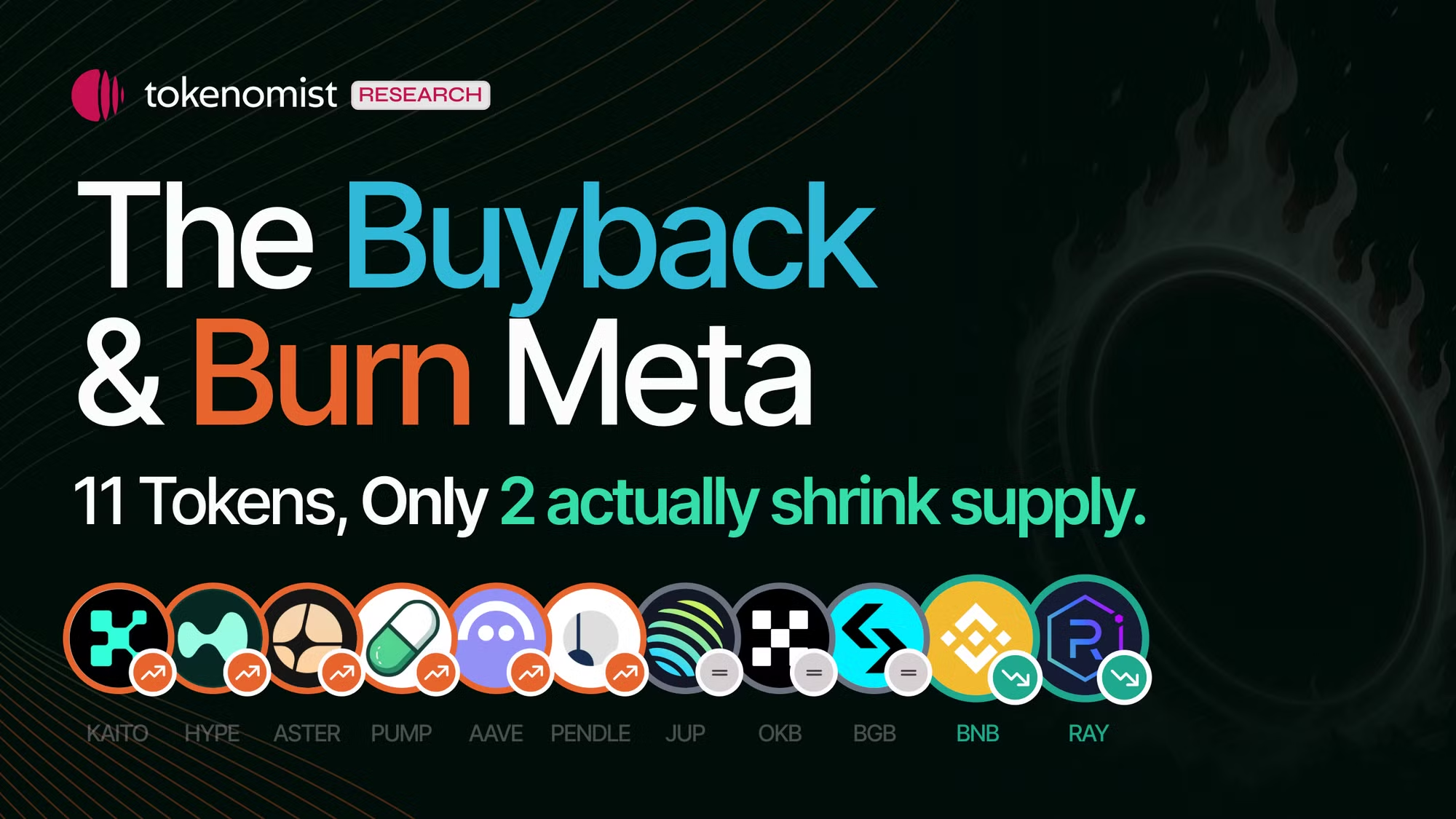
A supply-side walkthrough of the tokenomics trend of 2025 and 2026.
We start from the basics (what a buyback is, what a burn is), then read the real numbers for the crypto blue chips (BNB, ETH, the exchange tokens), the "buyback meta" leaders (HYPE, PUMP, ASTER, JUP), and the programs beyond the big four (PENDLE, AAVE, UNI, ETHFI, KAITO, RAY). These are some of the most notable programs.
Key takeaways
- A buyback removes tokens from the open market. A burn destroys them forever. They are not the same, and only a burn (or a buyback that ends in a burn) actually cuts total supply.
- The largest programs by name recognition are burns, not buybacks: BNB, ETH, and the exchange tokens. The buyback wave is newer and led by apps with real fee revenue.
- Where the money comes from for a buyback is what matters. A buyback paid for by real, recurring fees is durable. One paid for by treasury reserves or offset by fresh token unlocks is motion without much effect.
- Among these programs, only some actually reduce supply: HYPE closes its buyback into a burn, PUMP and RAY burn, while JUP holds the tokens in a trust and ASTER hands them back to stakers, so those two cut no supply.
- Even a real burn only shrinks supply if it outruns new issuance. HYPE and ETH are both net inflationary right now despite active burns, because unlocks or staking rewards add more than the burn removes.
- On a clean forward net-emission read, only BNB and RAY are genuinely shrinking supply. HYPE grows about 47% a year, ASTER about 24%, PUMP about 14%, and KAITO nearly 100%, while BGB nets to roughly flat once its remaining unlocks are counted.
- The announcement pop fades fast. Of 10 announcements measured, only OKB and AAVE clearly beat Bitcoin 30 days after announcing, the two with the most credible real action behind the headline.
How big is the buyback and burn wave since January 2025?
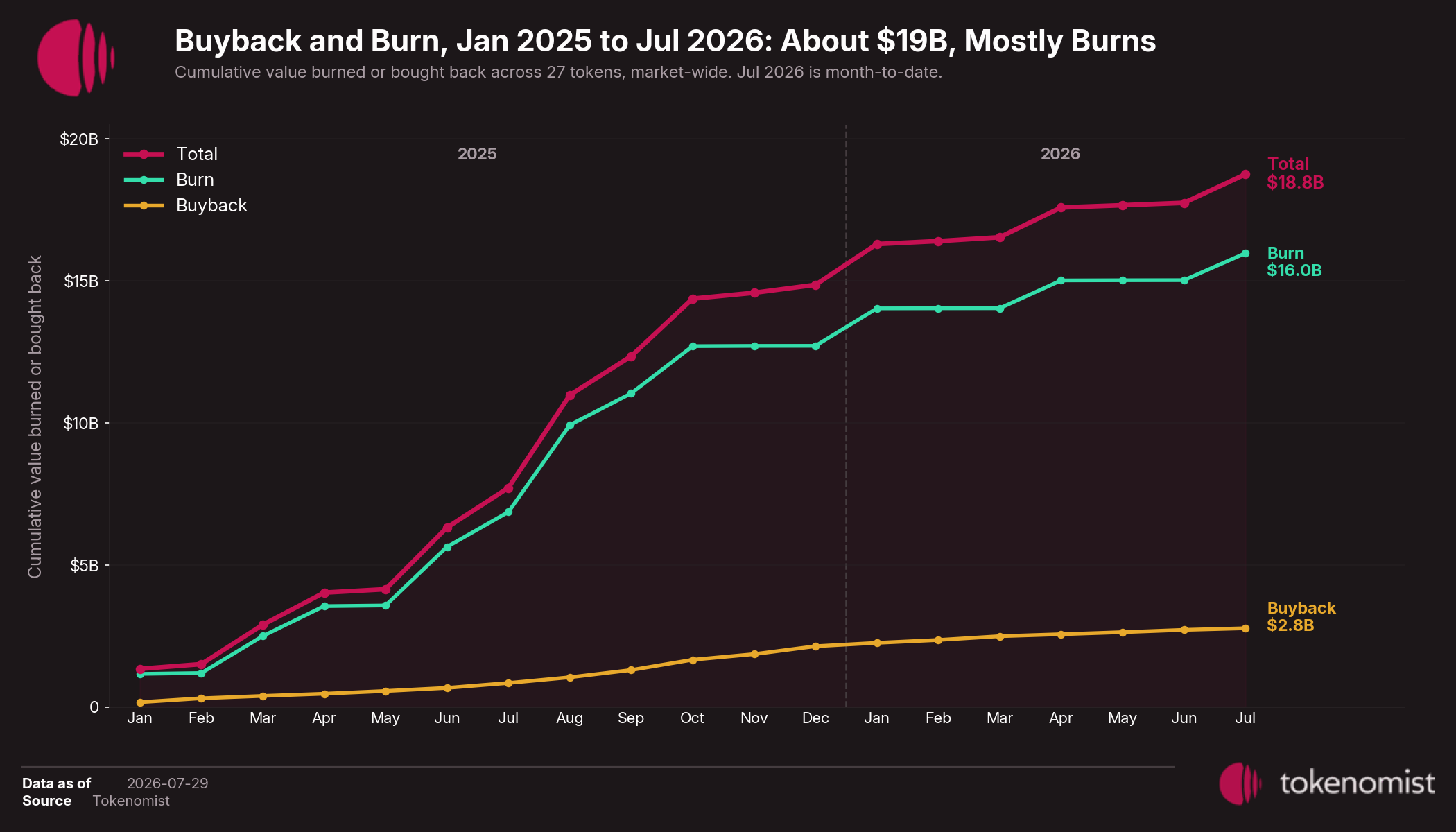
Zoom out and the scale is clear. Since January 2025, across all 27 tokens with recorded buyback or burn activity on Tokenomist (Bittensor subnets aside), the market has spent or destroyed about $18.8B:
- 2025 (full year): about $14.9B. $12.7B of burns against $2.2B of buybacks.
- 2026 so far (to late July): about $3.9B. $3.3B of burns against $0.6B of buybacks.
- Burns are more than four-fifths of the money, dominated by a few of the crypto blue chips: OKB's one-time cut, BGB, and BNB's quarterly Auto-Burn.
- The buyback meta that gets the attention, HYPE, PUMP, and the rest, adds up to only about $2.8B, a steady trickle next to the lumpy, far larger burns.
The loudest part of the trend is the smallest part of the money.
In this piece, 15 programs across three groups. Crypto blue chips: BNB, ETH, OKB, BGB, LEO. The buyback meta: HYPE, PUMP, ASTER, JUP. Beyond the big four: PENDLE, AAVE, UNI, ETHFI, KAITO, RAY. The opener chart above is market-wide (27 tokens); the net-emission test later covers the 11 with clean on-chain data.
1. What is a buyback?
A token buyback is when a project uses money it controls to buy its own token on the open market. The idea is borrowed from the stock market, where a company repurchases its own shares. The buying itself creates demand and absorbs some of the sell pressure from people cashing out.
The critical detail is what happens to the tokens after they are bought. There are three outcomes, and they matter enormously:
- Buyback and burn (the tokens are destroyed). This permanently reduces supply.
- Buyback and hold (the tokens go to a treasury or trust). This removes tokens from circulation for now, but they still exist and could return.
- Buyback and redistribute (the tokens are handed to stakers). This recycles the tokens straight back into circulation, so it does not cut supply at all.
A buyback is also only as strong as what funds it. A program paid for out of real protocol revenue (fees users actually pay) can run indefinitely. A program paid for out of a finite treasury runs until the treasury is empty.
One more limit worth stating plainly: a token is not a share. A shareholder has a legal claim on a company's earnings, so retiring shares concentrates that claim. A token holder usually has no such claim, so a token buyback removes float without concentrating any ownership right. The equity analogy is why the idea caught on, but it does not carry all the way over.
2. What is a burn?
A burn destroys tokens permanently by sending them to a burn address, a wallet with no private key (such as the zero or "dead" address, 0x000...dEaD) so the tokens can never be moved again. Unlike a buyback, a burn is irreversible.
Burns come in a few flavors:
- Protocol burns happen automatically as a side effect of network use. Ethereum's EIP-1559 burns part of every transaction fee. This is not funded by anyone; it is a rule of the network.
- Scheduled or "auto" burns destroy a pre-set amount on a timetable, like BNB's quarterly Auto-Burn.
- Buyback-and-burn first buys tokens with revenue, then burns them. This is the version that overlaps with the buyback discussion above.
The single most important test for any burn is whether it outpaces new issuance. If a project burns 1 million tokens a year but unlocks or mints 5 million, supply still grows. A burn headline means nothing until you net it against emission. We come back to this repeatedly below.
Quick vocab: total (or max) supply is every token that will ever exist; circulating supply is what trades now; float is the freely-tradeable slice. A buyback-and-hold shrinks float; only a burn shrinks total supply.
How tokens differ from stocks and bonds
Because buyback and burn borrow their logic from equities, it is worth placing a token alongside the assets it imitates. The mechanics rhyme, but the rights do not.
- A buyback resembles a share repurchase, up to a point. A company that buys back and retires its own shares leaves each remaining share with a larger claim on the business. A token buyback also removes float, but a token carries no legal claim on the protocol's cash flows or assets, so there is nothing to concentrate. The effect on price is real; the effect on ownership is not.
- A revenue-share resembles a dividend, but without the guarantee. A declared dividend is a legal obligation; a protocol paying fees to stakers (Pendle, GMX) can reduce or halt the payout at will, and holders have no enforceable right to it.
- A burn-only token with no fees sits closer to a commodity. Its value rests on engineered scarcity, like gold, rather than on a stream of earnings.
Side by side:
| Asset | What the holder gets | Enforceable claim? |
|---|---|---|
| Dividend stock | Dividends, buybacks, residual ownership | Yes (equity + fiduciary duty) |
| Government bond | Contractual coupon + principal back | Yes (contractual) |
| Fee-funded token | Buyback, burn, or staker payout, all discretionary | No |
| Burn-only, no-fee token | Engineered scarcity only | No |
So a crypto buyback can screen with a higher headline "yield" than a dividend stock, but you are giving up the legal claim, the enforceable payout, and any vote on how capital is used, and the cash flow behind that yield rises and falls with trading volume.
3. The crypto blue chips: the burns you already know
Before the buyback meta, the biggest supply-reduction programs were burns run by the largest tokens in the market. These are the reference points.
BNB (Binance): the scheduled auto-burn
BNB is burn-only, no buyback. It runs two mechanisms in parallel:
- Quarterly Auto-Burn: destroys an amount derived from BNB's average price and the number of BNB Chain blocks that quarter, so it is scheduled destruction rather than fee-funded buying.
- BEP-95: burns a fixed share (about 10%) of gas fees in real time on every block, which is fee-funded.
Both permanently cut supply, and the program continues until total supply reaches 100 million.
The 36th quarterly burn, executed 2026-07-15, destroyed 1,615,827.795 BNB, worth about $931.7M, cutting supply to 133.17M (BNB Chain blog, 2026-07-15). Cumulative burn stands near 67.4M BNB, so roughly 33.2M remain to reach the 100M floor. Market cap is about $76.2B.
The catch: because the Auto-Burn amount scales with price, it destroys more dollar value in bull markets and less in bear markets, which is arguably pro-cyclical.
ETH (Ethereum): the protocol burn that turned net inflationary
Ethereum's EIP-1559, live since 2021-08-05, burns the base fee of every transaction (EIP-1559 spec). It is the cleanest burn in crypto because it is automatic and funded purely by network demand, with no discretion and no treasury.
Cumulative burn is about 4.63M ETH. After the Dencun upgrade pushed activity onto Layer 2s, mainnet fees, and therefore the burn, fell below staking issuance, and total supply has been growing again since.
The catch: ETH still creates more than it burns. A little is burned on every transaction, but the network issues more new ETH to stakers than it burns, so total supply is still growing. It only turns deflationary in periods of heavy mainnet use. The burn is real; it just is not winning, which is the clearest proof that a burn does not automatically shrink supply.
The exchange tokens: OKB, BGB, LEO
Centralized exchanges have run buyback-and-burn on their tokens for years, funded by exchange profits.
- OKB shows what the end of a program looks like. In August 2025, OKX replaced its long-running quarterly burn with a one-time burn of about 65.26M OKB (worth roughly $3.05B at the time), capping total supply at a fixed 21M, down from a 300M maximum, and hard-coding the contract so no further minting or burning is possible (announced by @okx, 2025-08-13). As of 2026 there is no active OKB burn; supply is frozen at 21M.
- BGB (Bitget) runs a quarterly buyback-and-burn funded by 20% of Bitget's profits, with burn size now tied to on-chain gas usage. Cumulative burn is about 1.089B BGB, and it reconciles exactly with supply: 2B original minus 1.089B burned equals the 910.9M total supply CoinGecko shows today. The whitepaper revamp was announced by @bitgetglobal in late December 2024.
- LEO (Bitfinex/iFinex) commits at least 27% of iFinex's consolidated gross revenue to buying LEO on the market and burning it, continuing until every token is redeemed (LEO whitepaper, 2019, and Bitfinex Medium, 2019-06-14). Total supply has fallen from 1B to about 985M so far. It is one of the longest-running revenue-funded burns in the market.
The theme across the crypto blue chips: burns are credible when the funding is real (exchange profits, network fees), but the mechanism can be scheduled, ended, or simply outrun by issuance.
Want to run this lens on another token? All the unlock schedules, vesting curves, and buyback and burn ledgers behind this piece are on Tokenomist.

4. The buyback meta: HYPE, PUMP, ASTER, JUP
The 2025 to 2026 story is a wave of apps with real fee revenue routing that cash into buying their own token. These four are the anchors, though far from the only ones, and they span the full quality spectrum. Crucially, they do four different things with the tokens they buy.
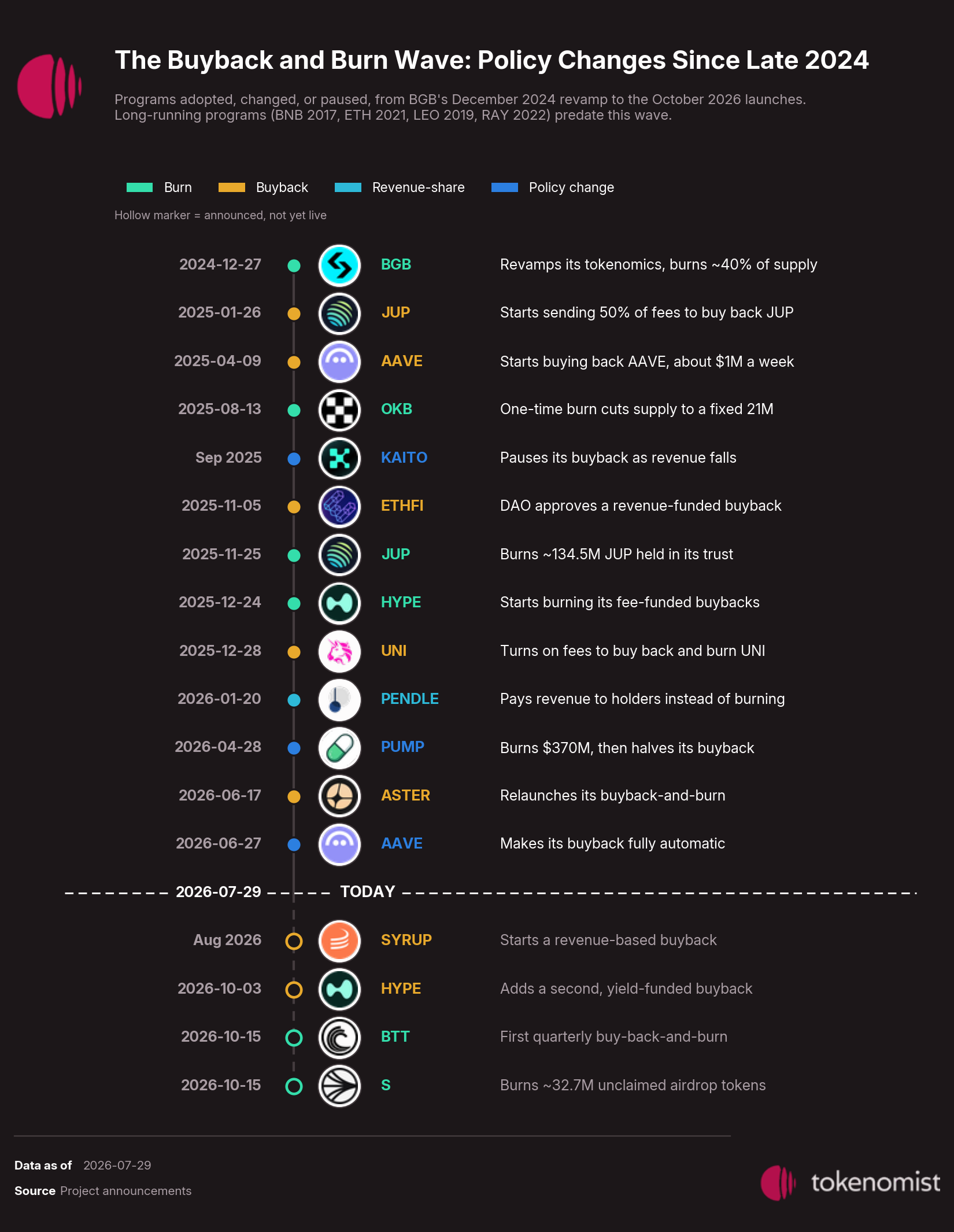
| Date | Token | What happened | Type |
|---|---|---|---|
| 2024-12-27 | BGB | Revamped tokenomics, burned ~40% of supply | Burn |
| 2025-01-26 | JUP | Started sending 50% of fees to buy back JUP | Buyback |
| 2025-04-09 | AAVE | Started buying back AAVE (~$1M/week) | Buyback |
| 2025-08-13 | OKB | One-time burn cut supply to a fixed 21M | Burn |
| 2025-09 | KAITO | Paused its buyback as revenue fell | Paused |
| 2025-11-05 | ETHFI | DAO approved a revenue-funded buyback | Buyback |
| 2025-11-25 | JUP | Burned ~134.5M JUP held in its trust | Burn |
| 2025-12-24 | HYPE | Started burning its fee-funded buybacks | Burn |
| 2025-12-28 | UNI | Turned on fees to buy back and burn UNI | Buyback |
| 2026-01-20 | PENDLE | Pays revenue to holders instead of burning | Revenue-share |
| 2026-04-28 | PUMP | Burned $370M, then halved its buyback | Policy change |
| 2026-06-17 | ASTER | Relaunched its buyback-and-burn | Buyback |
| 2026-06-27 | AAVE | Made its buyback fully automatic | Policy change |
| 2026-08 | SYRUP | Starts a revenue-based buyback (upcoming) | Buyback |
| 2026-10-03 | HYPE | Adds a second, yield-funded buyback (upcoming) | Buyback |
| 2026-10-15 | BTT | First quarterly buy-back-and-burn (upcoming) | Burn |
| 2026-10-15 | S | Burns ~32.7M unclaimed airdrop tokens (upcoming) | Burn |
HYPE (Hyperliquid): the flagship, buyback closes into burn
Hyperliquid is a perpetuals DEX (leveraged futures trading) and one of the highest-revenue apps in crypto. Its Assistance Fund routes about 97% of trading fees into continuous, open-market HYPE buybacks. In December 2025, a governance vote (85% support) formally recognized about 37.51M HYPE held in the fund's keyless address as burned, which closes the loop from buyback into an actual supply cut (@HyperFND, 2025-12-24). Cumulative buyback is about 45.9M HYPE (roughly $1.375B), and the burn now tracks it almost 1:1.
HYPE in the Assistance Fund system address of 0xfefefefefefefefefefefefefefefefefefefefe has been formally recognized as burned.
— Hyper Foundation (@HyperFND) December 24, 2025
The governance vote was based on stake-weighted consensus, with 85% of stake voting for burning, 7% against, and 8% abstaining. https://t.co/z8x1UyhjMW
Mechanically, it ticks every box: fee-funded, programmatic, verifiable, and it ends in a burn. With trailing 12-month revenue near $784M and a market cap around $12.2B, it trades at roughly 15.5x sales.
The honest caveat: HYPE is still net inflationary. Scheduled unlocks still outpace the roughly 1.2M per month burn, so the float keeps growing even with the buyback running full speed.
PUMP (Pump.fun): a genuine burn, but the policy was cut
Pump.fun is Solana's dominant memecoin launchpad, where anyone can mint and trade a new token in seconds. It originally routed 100% of net revenue into buybacks. On 2026-04-28 it burned everything it had bought (about $370M worth, roughly 36% of circulating supply) and cut the policy to 50% of net revenue, keeping the rest for operations and M&A (@Pumpfun, 2026-04-28). Cumulative buyback is about $300.4M spent (the $370M above is the market value of those tokens at the burn), and cumulative burn about 153.4B PUMP.
The future of $PUMP
— Pump.fun (@Pumpfun) April 28, 2026
We have burned ALL bought back $PUMP tokens, around $370M worth of purchases (~36% of circulating supply), to gain trust with our community.
On top of that, we have initiated a programmatic buyback *and burn* scheme at 50% of revenue for the next year to…
PUMP genuinely burns, but it is fragile:
- Revenue is falling fast: about $971M in 2025, now annualizing toward about $322M.
- The token trades about 78.5% below its September 2025 high.
- A 2026-07-12 insider unlock released about $135M, roughly 21% of circulating supply.
The buyback has softened the fall but not reversed it, and shrinking revenue means a shrinking defense.
ASTER: the buyback that cuts no supply
Aster is a perpetuals DEX and a fast-growing Hyperliquid rival. Its headline "198%" program is the most confusing name in the meta, so it is worth unpacking slowly. The 198% is simply two separate 99% legs added together:
- Leg 1, the buyback (99% of fees). Aster takes about 99% of daily trading fees and uses that cash to buy ASTER on the open market, then hands those tokens to veASTER stakers as Loyalty Rewards. Because the bought tokens are given to stakers rather than destroyed, this leg cuts no supply at all. It rewards holders, but the tokens go straight back into circulation.
- Leg 2, the burn (a separate 99%, from reserves). Aster also says it will burn an equal-sized amount, taken from its own team and reserve allocation (not from the fee-funded buyback), working toward cutting total supply from 8B down to 3B.
Add the two 99% legs and you get "198%". The label makes it sound like a doubly powerful buyback-and-burn, but the two legs draw from different pools and do different things: only Leg 2 (the reserve burn) actually shrinks supply, while Leg 1 (the fee buyback) just recirculates tokens to stakers. In plain terms, "198% buyback and burn" really means "99% of fees paid out to stakers, plus a separate promise to burn reserve tokens." Official framing: @Aster_DEX, 2026-06-17.
[Tokenomics Update] $ASTER Buyback and Burn Steps Up to 198%
— Aster 🥷 (@Aster_DEX) June 17, 2026
Aster is upgrading its buyback so the platform's own activity both rewards stakers and sets $ASTER on a deflationary path.
Starting from 12:00 PM UTC today, 99% of Aster's daily platform fees buy back $ASTER. An equal…
The catch is that the burn leg, the only part that shrinks supply, has largely stalled:
- On-chain, tok shows about 99.9M ASTER burned between January and May 2026 and nothing since, against the roughly 5B an 8B-to-3B target would require.
- Fees have collapsed to about $4.34M over 30 days, capping how much the buyback leg can even spend.
- The large cumulative buyback total (about $323.7M) is likely inflated by early one-time treasury tranches; only about $4M appears actually spent on the open market.
Net result: despite the deflationary branding, ASTER is still growing supply about 24% a year (see Test 1), because the buyback recirculates and the burn has paused. This is the weakest of the four on the axis that matters.
JUP (Jupiter): the buyback that holds, now under question
Jupiter is the leading DEX aggregator on Solana, routing trades across venues for the best price. It routes about 50% of fees into the Litterbox Trust, which buys JUP and holds it (reportedly under a multi-year lock) rather than burning it (@JupiterExchange, 2025-10). Of about 275.8M JUP ever bought back, only about half (roughly 134.5M) has been burned, in a single DAO-approved burn on 2025-11-25. The rest sits in the trust.
The next step in Jupiter’s Fresh Start initiative is here.
— Jupiter (@JupiterExchange) October 30, 2025
Following the scaling back of the DAO and our community reset, the Litterbox burn vote marks the next major step in our Fresh Start – refocusing $JUP as the center of our ecosystem and rebuilding long-term confidence and… https://t.co/CqzyaTEoEV
More tellingly, the program is under internal question. After spending well over $70M while JUP fell about 89% from its peak, a co-founder proposed halting buybacks in January 2026 to redirect the money to growth (Jupiter co-founder Siong on X, 2026-01-03). Annualized revenue is about $112.7M against a $626M market cap, so roughly 5.6x sales.
5. Beyond the big four: PENDLE, AAVE, UNI, ETHFI, KAITO, RAY
Beyond the four anchors, a broader group is either adopting buyback and burn or deliberately choosing a different model.
PENDLE: the counter-model (revenue share, no burn)
Pendle is a yield-trading protocol, where users split yield-bearing assets into a tradeable principal token and yield token.
It is also the clearest alternative to buyback and burn. Historically, vePENDLE lockers earned about 80% of protocol fees paid directly, like a dividend, with no burn and no buyback. Since January 2026, its new sPENDLE liquid staking token routes about 80% of revenue to stakers through a buyback-and-redistribute step, but it still never burns supply (@pendle_fi, 2026-01-20). Value reaches holders as cash-flow yield, not as scarcity. Annualized revenue is about $23M and falling. tok correctly shows no buyback and no burn for PENDLE, because there is none to record.
— Pendle (@pendle_fi) January 20, 2026
AAVE: a credible DeFi buyback (but it distributes, not burns)
Aave is the largest DeFi lending protocol, where users deposit to earn yield and borrow against collateral.
Its Aavenomics program buys AAVE with real protocol revenue and sends it to the ecosystem reserve for redistribution, not to a burn address (Aave governance, 2025-03-04). It began at about $1M per week (roughly $50M per year) and became fully automated and non-discretionary under Aavenomics 3.0, live 2026-06-27 (Aave founder Stani Kulechov on X, 2026-06). Backed by roughly $117.5M of annualized revenue, it is one of the larger revenue-funded buybacks in DeFi, even though it holds rather than burns.
You can now track AAVE buybacks via @Token_Logic's dashboard. pic.twitter.com/yXnWiEyF3c
— Aave (@aave) April 18, 2025
UNI (Uniswap): the fee switch is finally on
Uniswap is the largest decentralized exchange (DEX) for token swaps.
After years of debate, it turned on its fee switch. Governance Proposal 93 ("UNIfication") executed 2025-12-28, routing protocol fees into contracts that buy and burn UNI, plus a one-time retroactive burn of 100M UNI from the treasury (Uniswap Foundation vote; Uniswap blog, 2025-11-10). Fee capture began on Ethereum and has been rolling out across other chains through mid-2026. It is live, though the ongoing burn is still small relative to total fees (most of which still go to liquidity providers). Note: tok does not yet index this program, a coverage gap rather than an absence.
UNIfication has officially been executed onchain
— Uniswap (@Uniswap) December 27, 2025
✓ Labs interface fees are set to zero
✓ 100M UNI has been burned from the treasury
✓ Fees are on for v2 and a set of v3 pools on mainnet
✓ Unichain fees flow to UNI burn (after OP & L1 data costs)
Let the burn begin pic.twitter.com/fcr3WY3gPc
ETHFI (Ether.fi): revenue-funded, part burned, part redistributed
Ether.fi is a leading liquid restaking protocol, where you stake ETH and receive a liquid token that keeps earning.
It funds buybacks from real revenue: 100% of eETH withdrawal-fee revenue funds weekly buybacks, with part of other revenue funding monthly ones. Purchased ETHFI is partly burned and partly redistributed to sETHFI stakers (Ether.fi governance). A separate $50M treasury buyback triggers only while ETHFI trades below $3, which it currently does. The program is active as of mid-2026, on about $52.6M of annualized revenue. tok's series ends 2026-04-01, which appears to be a coverage lapse rather than a halt.
https://t.co/gbHcksxzp2 DAO passes $50M $ETHFI buyback proposal. https://t.co/SoSZiADHSe pic.twitter.com/c4lDdRwy5A
— ether.fi (@ether_fi) November 4, 2025
KAITO: a cautionary tale of a paused program
Kaito is an AI-powered crypto research and attention (InfoFi) platform.
Its buyback, funded by product fees and buying KAITO into the reserve (held, not burned), appears paused since September 2025. The cause is visible in the revenue: after X cracked down on InfoFi reward apps, Kaito sunset its Yaps product in January 2026, disrupting a core revenue driver (CoinDesk, 2026-01-15), and DefiLlama now shows near-zero recent fees. It is the clearest example of the rule that a fee-funded buyback stops the moment the fees do.
Announcing the $KAITO tokenomics!$KAITO will function as the main currency of our AI-powered InfoFi ecosystem.
— Kaito AI 🌊 (@KaitoAI) February 20, 2025
Driving Market Forces - with holders actively participating in shaping the network by influencing the distribution of attention
Network Currency - functioning as the… pic.twitter.com/tu1rhJUeVS
RAY (Raydium): the quiet, genuinely deflationary one
Raydium is a major automated market maker (AMM) and DEX on Solana.
No new policy, no relaunch, no vote. Raydium has simply run one of crypto's oldest continuous buyback programs since 2022: 12% of all trading fees automatically buy RAY, which is then burned (Raydium docs). Cumulative buyback is about $216M / 90.8M RAY across roughly 4,991 events. Because RAY emissions run only about 1.9M per year, far below the buyback pace, the program is genuinely net deflationary, which sets it apart from most of the field. It does this without a marketing campaign attached.
The same logic runs well beyond this selection. Other notable programs left out to keep the focus on the current wave and on tokens with clean data include Injective's weekly burn auction (INJ), PancakeSwap's buyback-and-burn (CAKE), KuCoin's exchange-token burn (KCS), and revenue-share models such as GMX and MakerDAO (MKR/SKY).
6. Does buyback and burn actually work? Three tests
A "$100M buyback" headline is a claim. Three tests turn it into evidence: does the program actually shrink supply once you net out new issuance, did the market reward the announcement beyond the broad market, and what are you paying for the cash the protocol generates.
Test 1: Net emission, does supply actually shrink?
A burn or buyback only matters if it beats what the token is issuing. So the test is simple: take each token's scheduled unlocks for the next 12 months, then subtract its recurring supply cut. The cut is measured from the trailing 12 months of actual burns, because future burns are not scheduled anywhere; the assumption is simply that each program keeps roughly its current pace. One-time events that will not repeat are removed from that trailing rate: HYPE's December 2025 burn recognition, PUMP's April 2026 mega-burn, BGB's one-time 220M burn in September 2025, and JUP's single Litterbox burn. Only mechanisms that actually destroy supply count, so ASTER's redistribute and JUP's hold count as zero.
| Token | Scheduled unlock (next 12mo) | Recurring supply cut (trailing 12mo) | Cut by | Net supply change (yr) | % of circulating |
|---|---|---|---|---|---|
| RAY | ~2M | 20.3M | buyback then burn | -18.4M | -6.8% |
| BNB | 0 | 6.0M | burn | -6.0M | -4.5% |
| JUP | 0 | 0 | none (holds) | 0 | 0.0% |
| OKB | 0 | 0 | none (frozen) | 0 | 0.0% |
| BGB | 12.1M | 9.1M | buyback then burn | +3.0M | +0.4% |
| PENDLE | 4.6M | 0 | none (revenue share) | +4.6M | +2.7% |
| AAVE | 0.45M | 0 | none (held) | +0.45M | +2.9% |
| PUMP | 82.2B | 25.7B | buyback then burn | +56.5B | +14.2% |
| ASTER | 636.9M | 0 | none (redistributes)* | +636.9M | +23.7% |
| HYPE | 119.0M | 14.3M | buyback then burn | +104.7M | +47.1% |
| KAITO | 241.2M | 0 | none (paused) | +241.2M | +99.9% |
* ASTER burned about 99.9M tokens between January and May 2026 but nothing since, so its burn is treated as stalled, not recurring (see section 4).
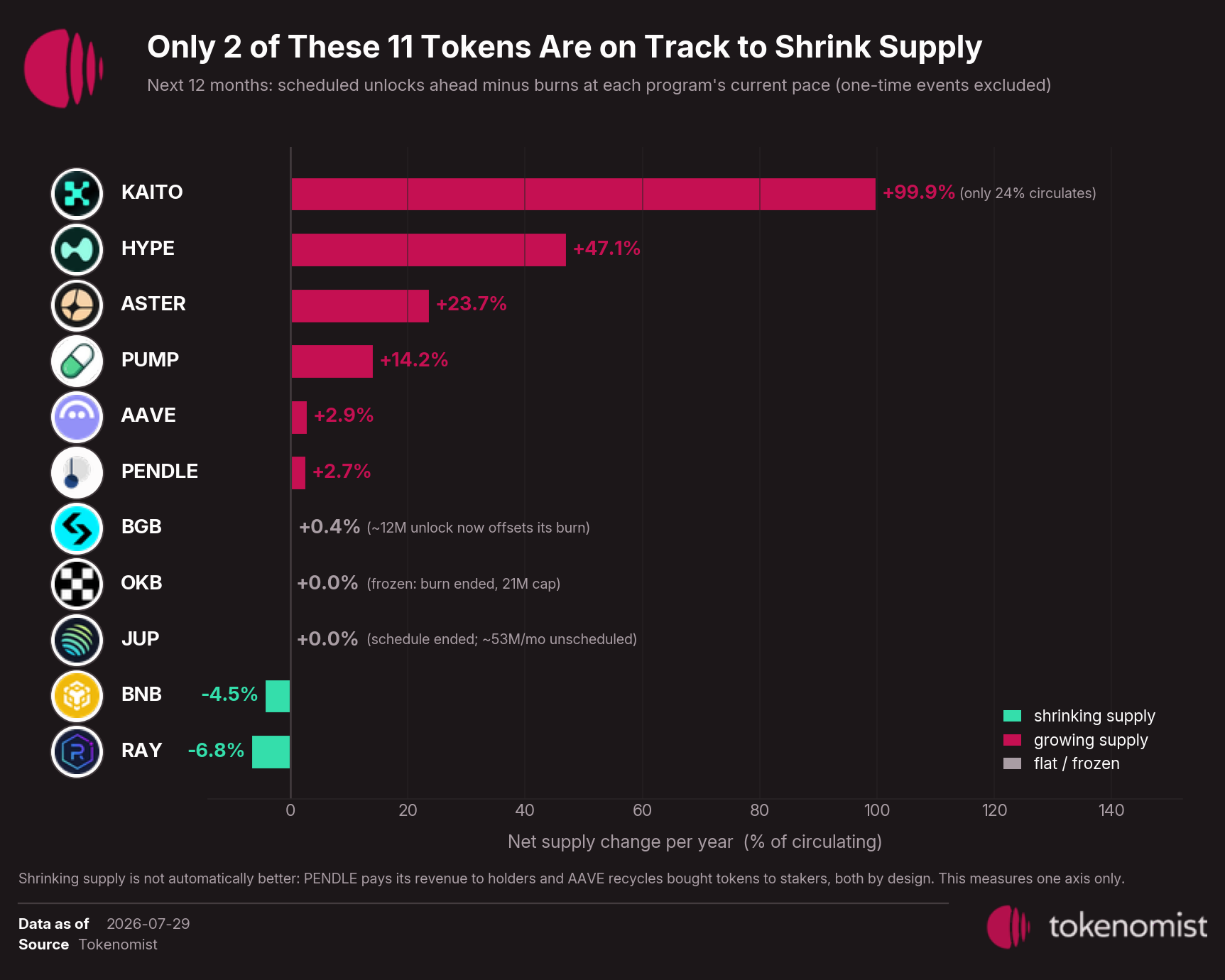
Read it carefully, because "has a buyback" and "shrinks supply" turn out to be almost unrelated:
- Only BNB and RAY are cleanly net-deflationary.
- HYPE, the flagship, inflates about 47% a year: its recurring burn (about 14.3M) is dwarfed by about 119M of scheduled unlocks over the next year.
- KAITO tops the list at nearly 100%: it unlocks almost its entire current float in a year, with no burn to offset it (its buyback is paused and only holds, not burns).
- ASTER (about 24%) and PUMP (about 14%) keep growing: ASTER hands its buyback to stakers, and PUMP's burn no longer keeps pace with its unlocks.
- BGB is now roughly breakeven: about 12M of remaining unlocks a year cancel its roughly 9M burn, so it drops out of the shrinking set.
- JUP and OKB read zero: JUP's scheduled unlocks have ended and its buyback only holds rather than burns, while OKB is frozen at its 21M cap.
Two things this table does not say. KAITO's reading near 100% is high because its float is small, not because its unlock is unusually large: only about 24% of its supply circulates, so one year of scheduled vesting is nearly the whole float, and every token that launched in 2025 sits somewhere on this curve. And shrinking supply is not automatically better: PENDLE pays its revenue to holders and AAVE recycles bought tokens to stakers, both deliberate designs rather than failures. This test measures one axis only, whether net supply goes down.
Test 2: Price reaction, did the announcement matter?
We took each program's announcement date and measured the token's price change 7 and 30 days later, then subtracted Bitcoin's move over the same window to isolate the token-specific reaction (excess return). The table shows both the raw move and the Bitcoin-adjusted figure, from daily 00:00 UTC prices. Positive means it beat the market after announcing.
| Token | Announcement | +7d | +30d | +7d vs BTC | +30d vs BTC | Event |
|---|---|---|---|---|---|---|
| OKB | 2025-08-13 | +158.1% | +314.8% | +164.3% | +318.7% | One-time ~$3.05B burn, supply to 21M |
| AAVE | 2025-04-09 | +7.3% | +64.1% | -2.3% | +29.1% | Aavenomics buyback launch |
| PUMP | 2026-04-28 | +2.8% | +0.9% | -0.4% | +4.8% | $370M burn plus policy cut |
| ASTER | 2026-06-17 | -3.7% | -6.6% | +0.7% | -3.8% | "198%" relaunch |
| BGB | 2024-12-27 | -14.0% | +3.4% | -15.2% | -6.2% | Whitepaper burn revamp |
| PENDLE | 2026-01-20 | -1.0% | -38.8% | +3.6% | -10.6% | sPENDLE launch |
| HYPE | 2025-12-24 | +8.4% | -10.6% | +7.3% | -13.0% | Governance recognizes fund as burned |
| JUP (launch) | 2025-01-26 | -3.8% | -29.4% | +0.1% | -16.6% | Litterbox buyback launch |
| UNI | 2025-12-28 | -0.6% | -20.9% | -3.8% | -21.5% | UNIfication fee switch |
| JUP (burn vote) | 2025-10-30 | -15.1% | -40.1% | -9.5% | -22.7% | Litterbox burn vote |
The pattern is stark. At 7 days, about half the programs beat Bitcoin, a modest pop. By 30 days, only OKB and AAVE clearly beat it, both up sharply; PUMP roughly held flat while Bitcoin fell, and the rest underperformed the market, several badly. The two standouts share the most credible, tangible action behind the announcement: OKB permanently destroyed most of its supply, and AAVE buys with real, recurring fee revenue. The loudest branded program, ASTER's "198%", barely moved: roughly flat against Bitcoin at 7 days and behind it by 30. This is a small sample of 10 and a correlation, not proof of causation (market-wide moves and other news are not controlled for), but the direction is consistent.
Test 3: Valuation, what are you paying for the cash?
To value a buyback-and-burn token, no single ratio is enough, so we use five angles. Price-to-sales (P/S) divides market cap by trailing 12-month protocol revenue, the closest thing to a P/E: in crypto, fees are the total users pay, revenue is the slice the protocol keeps (the rest goes to liquidity providers or other suppliers), and revenue is the pool a buyback can actually draw from. Price-to-fees (P/F) uses total fees instead, a steadier basis where the revenue split is murky. FDV/revenue swaps market cap for fully-diluted value, exposing the dilution still to come from unlocks. Buyback yield is the annual buyback spend as a share of market cap, the shareholder-yield analog. And the revenue trend flags whether that cash flow is growing or shrinking. Figures are trailing 12 months, as of 2026-07-29.
| Token | Market cap | Revenue (1y) | Price-to-sales | Price-to-fees | FDV / rev | Buyback yield | Revenue trend |
|---|---|---|---|---|---|---|---|
| PUMP | $778M | $325M | 2.4 | 1.9 | 5 | 36% (burned) | falling |
| JUP | $626M | $112M | 5.6 | 1.7 | 12 | 9% (held) | falling |
| RAY | $163M | $28M | 5.7 | 1.0 | 12 | 15% (burned) | falling |
| ETHFI | $402M | $52M | 7.7 | 1.8 | 8 | n/a* | flat |
| PENDLE | $253M | $23M | 10.8 | 10.5 | 18 | 7% (redistr.) | falling |
| AAVE | $1.54B | $117M | 13.2 | 1.7 | 14 | 2% (held) | falling |
| HYPE | $12.2B | $784M | 15.5 | 11.8 | 70 | 6% (burned) | falling |
| UNI | $2.42B | $27M | 88.8 | 2.8 | 127 | n/a* | mixed |
| ASTER | $1.67B | n/a | n/a | 3.8 | n/a | ~0%* | falling |
* n/a means the on-chain data is incomplete: ETHFI's series ends 2026-04-01 (a coverage lapse), and UNI's fee-switch burn began 2025-12-28 and is not yet fully indexed. ASTER is not a data gap: only about $4M of its buyback was actually spent on the open market, so its real yield rounds to ~0%.
The valuation lens delivers the sharpest twist of all three tests: cheap and good are not the same thing. RAY, the only token here that genuinely shrinks supply, is not the cheapest, and where it looks pricey (FDV/revenue) that is only because its revenue is tiny, not because the market pays up for deflation. PUMP looks cheapest at 2.4x sales, until you see revenue falling behind a 36% buyback yield it cannot sustain, a classic value trap.
HYPE costs 15.5x on market cap but 70x on FDV, because only about a fifth of its supply is circulating, the unlock overhang the headline P/S hides. And almost every program here runs on falling revenue, so these multiples only get more expensive unless the cash comes back. Read valuation with Tests 1 and 2, never on its own. (ASTER shows no P/S because DefiLlama does not track its revenue, so only P/F is shown; its buyback is also inflated by treasury tranches, with about $4M actually spent on-market.)
Conclusion: what the three tests say
Put the three tests together and the field sorts cleanly:
- Real and durable (cuts supply, held up after announcing, or both): RAY (quietly net-deflationary, no announcement needed), BNB (scheduled, clean), and OKB and AAVE (the two clear standouts 30 days after announcing). ETH, BGB, and LEO on the burn-only side, though ETH is net inflationary post-Dencun, and BGB now nets to roughly flat once its remaining unlocks are counted.
- Real but fragile: PUMP (genuine burn, but revenue falling, price down, and supply still growing about 14% a year), HYPE (the biggest buyback, but still inflating and the pop faded), UNI (live but early, and it underperformed after launch).
- Buys but does not cut supply: ASTER (redistributes, inflating, and fell behind BTC by 30 days), JUP (holds, and a co-founder proposed halting it).
- Deliberately different: PENDLE pays a cash yield instead of shrinking supply, the cleanest "crypto dividend".
- Stopped: OKB (its recurring burn has concluded, though the one-time cut to 21M is permanent and was the best 30-day performer), KAITO (paused along with its revenue).
The headline "$100M buyback" tells you almost nothing. Ask what funds it, whether it actually shrinks supply net of issuance, and whether the market ever rewarded it. On all three, most of this meta is weaker than its announcements, and a couple of quiet names (RAY, and on the burn side BNB) are stronger than their press.
Frequently asked questions
What is the difference between a token buyback and a burn?
A buyback uses a project's own money to buy its token on the open market. A burn permanently destroys tokens by sending them to a wallet no one can access. Only a burn, or a buyback that ends in a burn, actually reduces total supply. A buyback that holds or redistributes the tokens removes them from circulation for now, but they still exist and can return.
Does a token buyback reduce supply?
Not on its own. A buyback only shrinks total supply if the bought tokens are then burned. If they go to a treasury, a trust, or back to stakers, total supply is unchanged and only the freely traded float is affected, which can later reverse.
Which tokens actually shrink their supply after netting out unlocks?
Of the programs we tested, only BNB and RAY are cleanly net-deflationary once you subtract the next 12 months of scheduled unlocks from the trailing-12-month burn. HYPE inflates about 47% a year, ASTER about 24%, PUMP about 14%, and KAITO nearly 100%, while BGB is now roughly breakeven, and JUP and OKB come out at zero.
Is a buyback and burn good for the token price?
Not reliably. Measuring each program's price move against Bitcoin, about half beat the market 7 days after the announcement, but by 30 days only OKB and AAVE clearly did. A buyback can support price, but the announcement alone rarely produces lasting outperformance. This is research, not financial advice.
What funds a buyback, and why does it matter?
A buyback paid from real, recurring protocol revenue (the fees users actually pay) can run indefinitely. One paid from a finite treasury runs only until the treasury empties. The funding source is the single best signal of whether a program is durable.
Is a token buyback the same as a stock buyback?
No. A share buyback concentrates a legal claim on company earnings across fewer shares. A token usually carries no such claim, so a token buyback removes float without giving holders an enforceable slice of profits. The mechanics rhyme, but the rights do not.
Methodology
- Net emission (Test 1): forward 12-month scheduled unlocks (the full 52-week tok emission schedule, 2026-07-29 to 2027-07-29) minus the trailing 12 months of recurring supply cuts (2025-07-29 to 2026-07-29), with major one-time events removed, as a percent of circulating supply. Only supply-destroying mechanisms count; buyback-and-hold (JUP) and buyback-and-redistribute (ASTER) count as zero, and supply with no published unlock date (TBD) is excluded from the forward number.
- Price reaction (Test 2): token and Bitcoin daily prices (00:00 UTC snapshots, CoinGecko) at the announcement date plus 7 and 30 days; excess return is the token's change minus Bitcoin's, shown alongside the raw change. A descriptive event study on a small sample (10 events), not a causal claim: market-wide moves and other news are not controlled for, and the choice of announcement date affects the result.
- Valuation (Test 3): price-to-sales on trailing-12-month revenue, price-to-fees on total fees, FDV/revenue, buyback yield, and the revenue trend.
- No double-counting: one figure per token (burn ledger for pure-burn programs, buyback ledger otherwise), so buyback-and-burn is never counted twice. Bittensor subnets are excluded.
- Known caveats: ASTER's cumulative buyback is likely inflated by early treasury tranches; some official X links sit behind a login wall and were corroborated by project blogs and reputable outlets; several revenue figures move quickly and are stated as of 2026-07-29.
Sources
- Tokenomist (tok): on-chain buyback and burn events (the source of truth), plus token supply and unlock schedules, via its CLI and API. Where tok's market-cap fields are stale, CoinGecko is used instead.
- CoinGecko: market cap, FDV, price, and circulating supply (as of 2026-07-29).
- DefiLlama: protocol revenue and fees (as of 2026-07-29). "Fees" is what users pay; "revenue" is the protocol's retained share.
- Etherscan: ETH supply and cumulative burnt fees.
- Program announcements, each project's own post or governance record: BNB, ETH, OKB, BGB, LEO, HYPE, PUMP, ASTER, JUP, PENDLE, AAVE, UNI, ETHFI, RAY. KAITO's pause was never formally announced; it is inferred from its on-chain buyback ledger, which shows no purchases since 2025-09-23.
- News events are cited inline to their outlets (e.g. CoinDesk on Kaito's Yaps sunset).
Supply-side analysis using the Tokenomist CLI and API. Not financial advice.
Recommend Article